Monthly Archives: March 2013

The Mysteries of Easter Island

Is there a more unique and compelling place in the world than Easter Island? Most people are at least vaguely aware of the island and its mysterious Moai statues, but few have visited here because it is just so remote. The nearest inhabited island is 1,300 miles away (Pitcairn Island, with 50 residents) and the nearest continental point is almost 2,200 miles away in Chile.  This time of year only one flight per day arrives to Easter Island, from either Santiago or Papeete; in the peak seasons it increases to 16 flights per week.

I arrived on the weekly red eye from Papeete and landed on the longest runway in either Chile or Polynesia, more than four kilometers in length. Some years back NASA paid to have it expanded to serve as an emergency landing spot if the space shuttle ever got into trouble out here in the middle of nowhere.

OLYMPUS DIGITAL CAMERA

The island is triangular, and just 63 square miles. There are surprisingly few trees, and the coastline is rugged and very links-like; a golf course architect would see a myriad of possibilities here. It’s not nearly as mountainous as Tahiti, the elevation changes provided by the four large volcanoes and 70 smaller ones that punctuate the landscape. I visited the largest volcano, Rano Kau, the first day; it’s 1.5 kilometers in diameter and as perfect a volcano as you’ll ever see, although a big section of the crater rim to the east looks like someone took a bite out of the pie crust. Rano Kau last erupted 2.5 million years ago.

OLYMPUS DIGITAL CAMERA

There are 7,000 inhabitants of Easter Island, 4,000 native Rapa Nui and 3,000 mainland Chileans who cannot own land but rent because there are jobs and no taxes. Like Tahiti, tourism is the primary industry, with 100,000 visitors per year; there is some fishing and a little bit of agriculture, but that’s about it. Everything the locals and hotels need is imported, a challenge because there is no port. Onions or autos, it is all offloaded onto barges and brought ashore. Hanga Roa, in the southwest corner next to the airport, is the island’s only real town.

In the Kuala Lumpur airport I met an adorable little Kiwi girl on her way home to Auckland who told me Easter Island got its name because the Easter bunny lives there. She was close. The first European visitor to the island was a Dutchman named Jacob Roggeveen who arrived on Easter Sunday in 1722, and so named it. Unfortunately when we were there the Easter bunny was in abstentia, gearing up for his big weekend. Or is it her big weekend?

The Polynesians who first arrived here around the year 400 called it Te Pito O Te Henua, “The Navel of the World,” (every island in Polynesia has a navel) and eventually Rapa Nui, “The Big Land.” All the indigenous people became known as Rapa Nui. The first to migrate here were the long ears, Polynesians who wore heavy jewelry in their ears to elongate their lobes. The second migration hundreds of years later brought the short ear people, who were welcomed by the long ears and then informed they would be doing the hard labor. Thus enslaved, it was the short ear people who not only carved but also transported the legendary statues, the Moai.

DSCN2620

Between the years 800 and 1600 the Rapa Nui made or started to make 900 Moai to represent the incarnation of the spirit of their kings and chiefs, who were buried in the ahu, the elaborate stone altars on which the Moai were placed. In this way the Moai represented a resurrection of sorts for the chief: eternal life.  The statues all stood along the coast and faced inland, toward the families they were there to protect.

The Rapa Nui had no metal and used the harder obsidian and basalt rock as tools to carve the statues out of the softer volcanic tuff. Each Moai included the head and torso, long ears, arms, and hands folded in front of the

"Topknots" provided the chiefs' red hair.

“Topknots” provided the chiefs’ red hair.

belly, with long fingernails. In later years the chiefs started dying their long hair red and wearing it knotted on top of their head, so the newer Moai also featured a red “topknot” that was carved at a separate quarry where not long ago 700 topknots were found. Once the statues were solidly anchored on the ahu the eyes were added, usually made of white coral, and only when the eyes were in place was a Moai considered alive.

The individual statues averaged about 16 feet high but several have been found over 30, and they weigh between 40 and 80 tons. The Rapa Nui got more ambitious over the years and the larger statues represent later efforts, rather than more important chiefs.

How they were transported is one of the many Moai mysteries. Natives claim they walked to their respective ahu. Since the island was covered in thick Chilean palm trees, for a time it was believed the tree trunks were used to roll the statues to their location, but that has been disproved. Scientists now find evidence that the Moai did indeed walk, or rather were walked by the Rapa Nui, who picked up one side and then the other, moving it slowly forward as the statue was upright. As with the Great Pyramids or Stonehenge we’ll never know for sure, but what we do know is that 250 of the ahu platforms were constructed – you can see their ruins up and down the coast – and that 400 Moai eventually reached their positions on the ahu.

By 1600 the population of Easter Island had grown to an unmanageable 20,000 and all the natural resources had been depleted, including the trees. The working class short ears finally had enough and went to war with the long ears, in the process knocking over all of the 400 Moai that had been erected around the island. They were toppled face down so the eyes would fall out or be easily removed, rendering them good and truly dead. All of the 36 Moai standing today have been excavated, restored and replaced on their ahu since 1960.
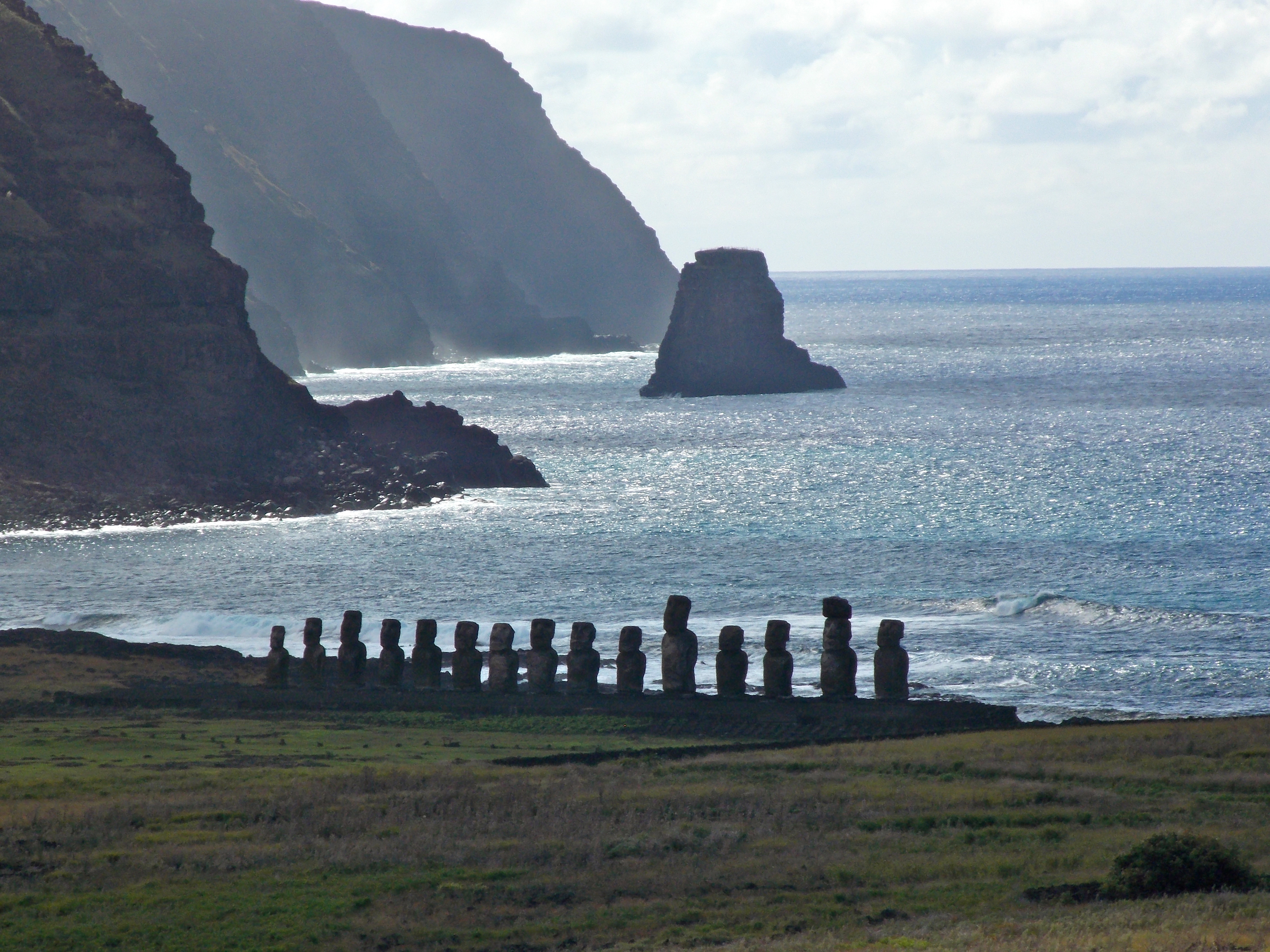
The Ahu Tongariki shrine, from the Moai quarry several miles away.

The Ahu Tongariki shrine, as seen from the quarry several miles away.

The most impressive array of Moai today is at Ahu Tongariki on a stunning piece of property on the northeast coast of the island. In 1960 the ruins of this shrine were devastated by a tidal wave, but in 1991 the Japanese company Tadano, which makes cranes and other large construction equipment, undertook a massive excavation project. The company’s motto is: “Tadano can even lift history,” and they proved it; Ahu Tongariki is the largest shrine on the island, and the 15 statues here lord over the plain to the west, impassive and yet fierce.

I should have included more people in these pictures, for scale, but maybe the guy in the green shirt will provide some perspective.

I should have included more people in these pictures for scale, but hopefully the guy in the green shirt provides some perspective.

We visited the only Moai not on the coast, the seven statues of the Ahu Akivi. They do not represent chiefs or kings, but rather explorers sent by an ancient king to find an island he saw in his dreams. They face “home” … west, to Polynesia.

The seven explorer Moai of Ahu Akivi, facing west to their Polynesian homeland.

The seven explorer Moai of Ahu Akivi, facing west to their Polynesian homeland.

Adjacent to Anakena, the best beach on the island, is Ahu Nau Nau, which features five full-sized Moai, four with topknots.
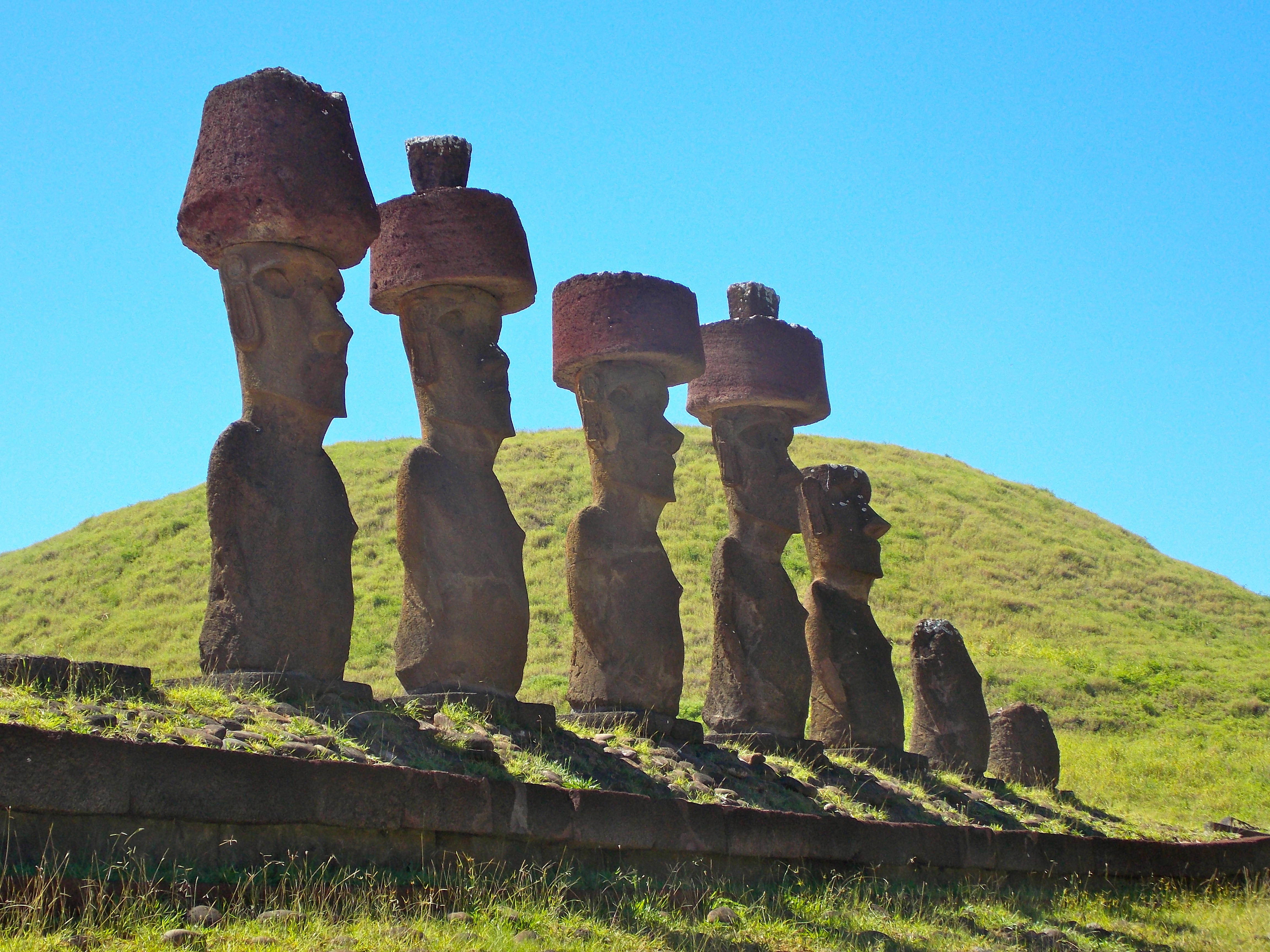
Ahu ---- includes four Moai with topknots.

Ahu Nau Nau

And within walking distance from my hotel was Tahai, a complex of three small temples featuring Moai that draw a crowd every evening as the sun sets behind them.

The temple at T---- is a popular spot at sunset.

The temple at Ahu Tahai is a popular spot at sunset.

But the coolest place of all is Rano Raraku, the volcano/quarry where most of the Moai were carved. Of the 900 discovered statues, 400 are still in the quarry, in various stages of completion. Some are just heads, some have been half buried over time, some are still embedded into rock on the side of the volcano. The Moai on the various ahu around the island have been excavated and restored over the past 50 years, but Rano Raraku seems so authentic, and provides insight into the remarkable effort that went into creating just one of these massive icons. Some of the completed Moai at the quarry were never toppled, left standing by the short ears because they hadn’t yet received their eyes.
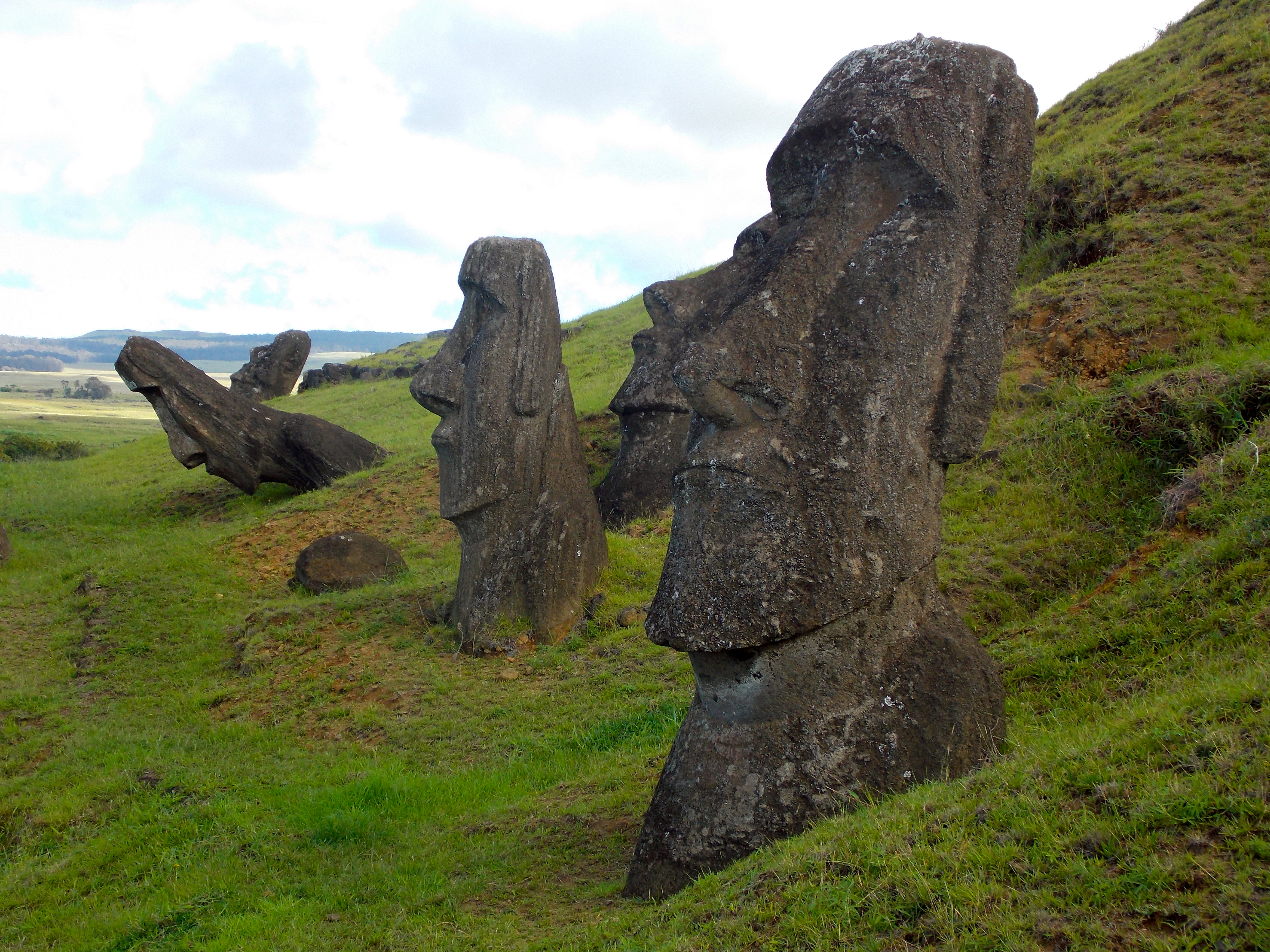
Heads of some of the 400 Moai at the main quarry site.

Heads of some of the 400 Moai at the main quarry site.

One quick story before leaving Easter Island. Around 1660, after the war had ended and the royal family had been killed, leaders of the island came together and decided they needed a democratic way to choose a new king. Each family, or tribe, sent a representative to an annual meeting at Orongo, on the rim of the Rano Kua volcano. Just

The far island is Mota Nui, where the frigate birds nested.

The far island is Motu Nui, where the frigate birds nested.

off the coast is an island called Motu Nui, where frigate birds nest in September. So they decided on a competition. Each family’s designee would descend the 300-meter cliff to the ocean, swim the kilometer and a half to the island, find the egg of a frigate bird, attach it to his head protected by moss and leaves, swim back to shore, climb the cliff and run to the finish. The first to cross the line with an unbroken egg was declared the winner, and his chief was crowned king for the following year. If we could only come up with a similar system in the U.S., we could eliminate campaign commercials.

The “birdman” competition continued for 200 years, until Christianity arrived around 1864. And now one airplane per day brings people to this remarkable place, to see the captivating remnants of one of the world’s most fascinating cultures.
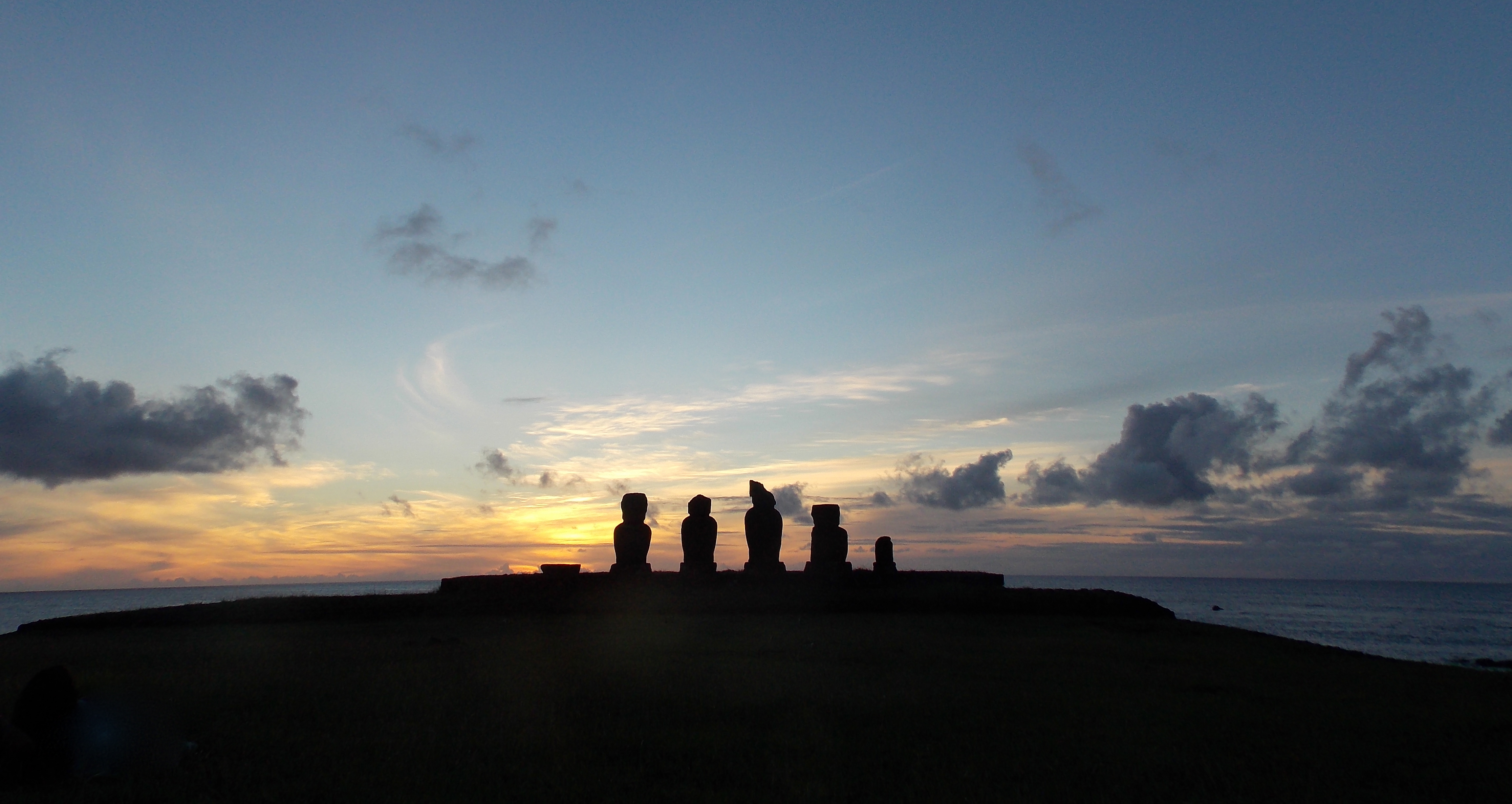
My favorite picture from Easter Island

Probably my favorite picture from Easter Island

A group of very nice and fun Colombians pose at Ahu Akivi.
A group of very nice and fun Colombians pose at Ahu Akivi.

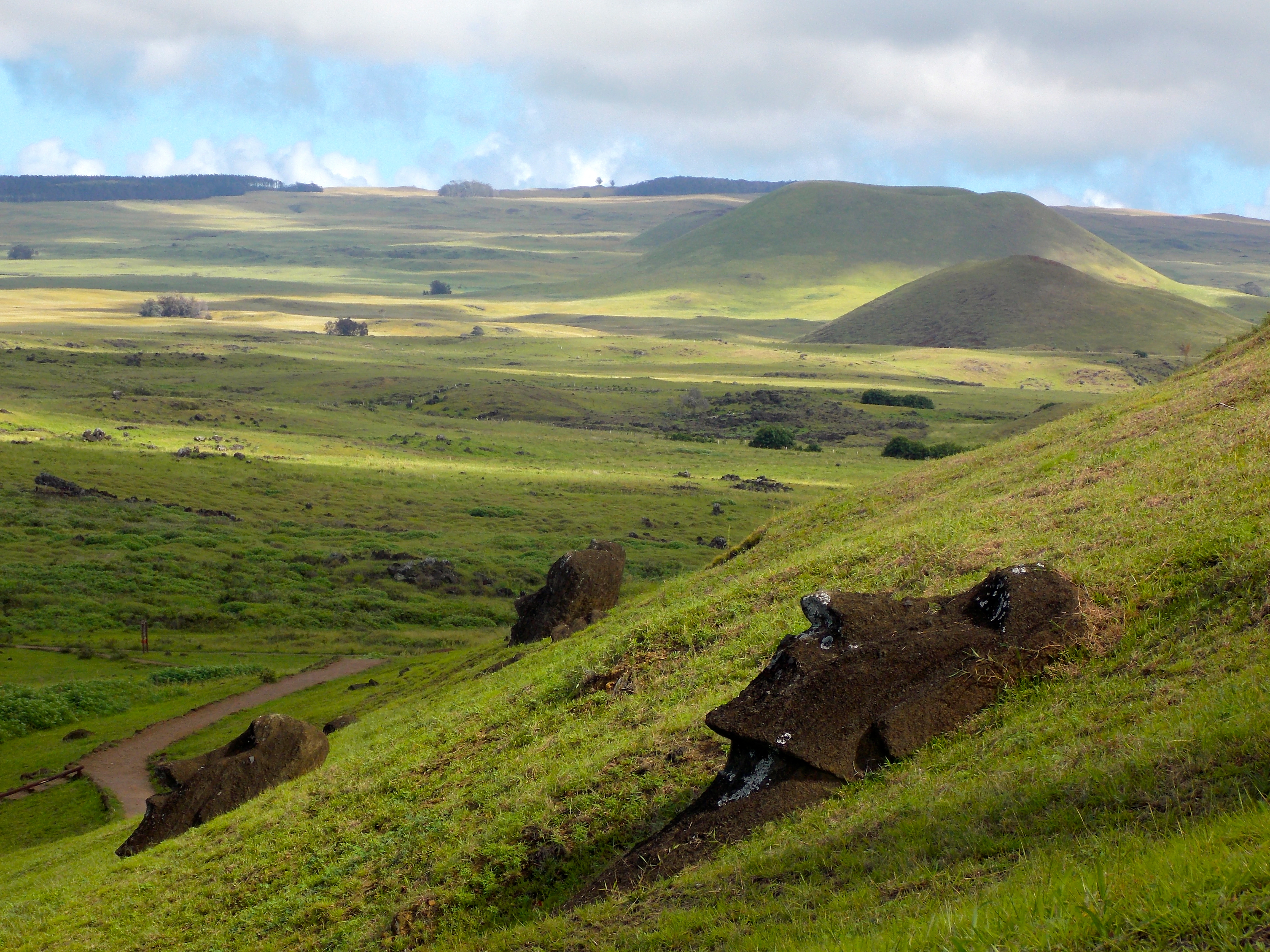
From the quarry a good look at the treeless terrain and a few of the small volcanoes.

From the quarry a good look at the treeless terrain of Easter Island, and a few of the smaller volcanoes.
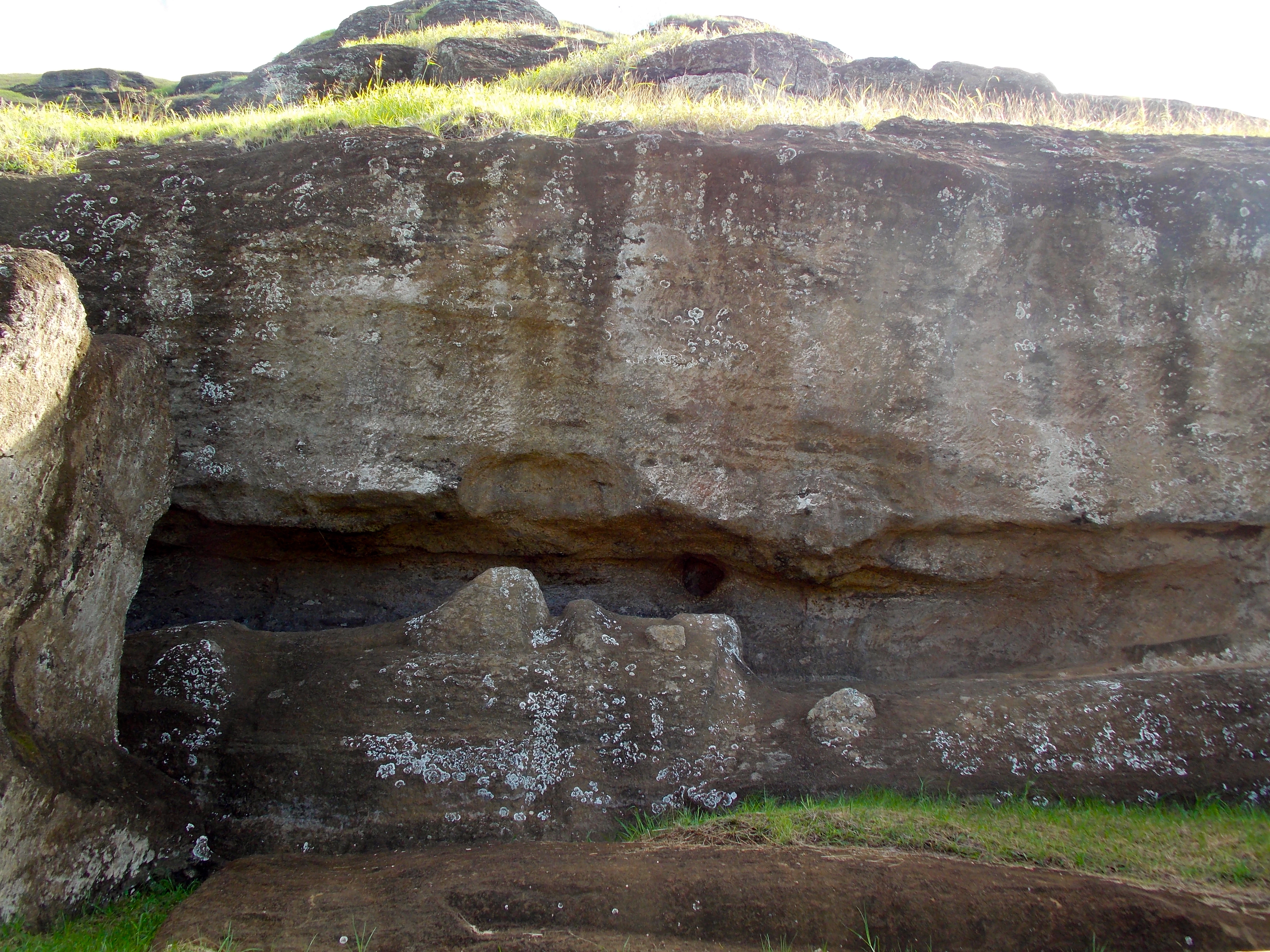
This poor guy never made it out of his volcanic birthplace.

This poor guy never made it out of his volcanic womb.

The colors of the Pacific and the rocky coastline were a stunning combination.

The colors of the Pacific and the rocky coastline are a stunning combination.
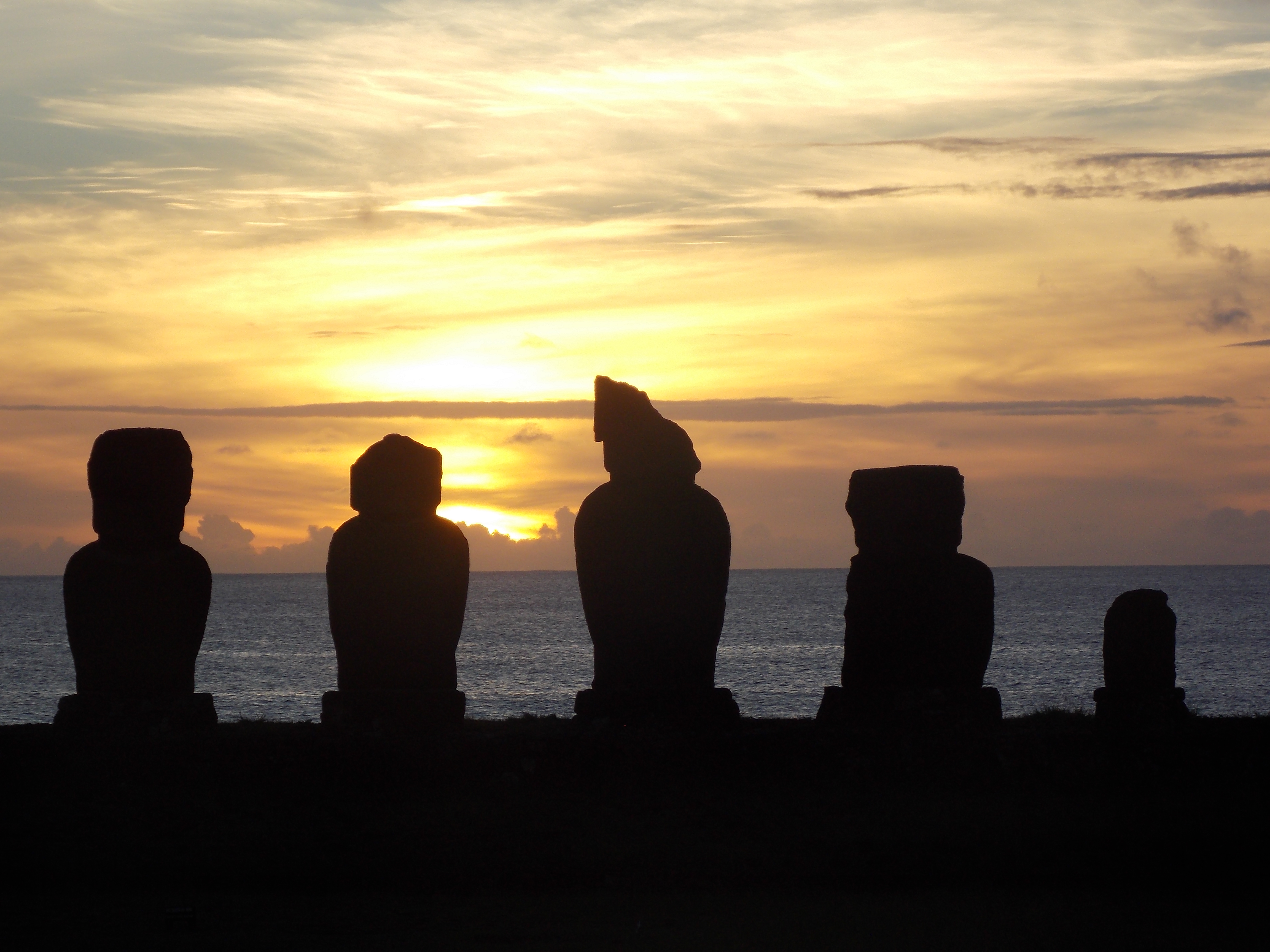
Recognize the fourth guy from the left? We didn't know that when he was phoning home, home was really Easter Island. Cheers!

Recognize the fourth guy from the left? We didn’t realize that when he was phoning home, home was really Easter Island. Cheers!

Categories: Uncategorized

Tahiti

(NOTE:  I just checked into my hotel in Santiago and figured I’d post Tahiti tonight and Easter Island tomorrow, on the day it is named after. I hope you all have a wonderful Easter Sunday!)

Like most people, I suppose, I’ve long harbored a romanticized image of Tahiti as the ultimate tropical paradise. Friends have told me that it’s crowded and crime-ridden, and that Moorea, Bora Bora and other islands are the places to go, but since I was coming this way I decided to stop for a few days and check it out for myself.

I’ve never flown across the Pacific Ocean before, always up and over Alaska, and it is just enormous, twice the size of the Atlantic. Kuala Lumpur to Auckland was a ten-hour flight, Auckland to Tahiti six, and it will be six from here to Easter Island and five to Santiago, Chile. That’s a lot of water, and within the waters of the Pacific are 30,000 islands, including Tahiti and its surrounding neighbors in French Polynesia.

DSCN2569

I did a half-day tour of Tahiti Nui (“big island”) and Dave – a Hawaiian who came here 27 years ago to surf, fell in love and never left – gave us some of the history. Southeast Asians first populated Tahiti more than 1,000 years ago. That fact has been disputed over the years, and a Norwegian named Thor Heyerdahl built a raft he called Kon-Tiki, and sailed from Peru to show it could have been South American natives who first settled here. Despite the fact that Kon-Tiki had maneuverability issues and crashed on some rocks, Heyerdahl made it far enough to demonstrate he could have been correct. But he was ultimately overridden by the most modern of theory-busters, DNA testing, which proved that the blood of Tahitian natives is Taiwanese in origin, as is the language, which probably should have been a clue.

Dave told us that human sacrifice and cannibalism were part of the culture here for centuries, and it took a concerted effort on behalf of the Europeans to eventually wipe out those practices through the introduction of Catholicism. But though they were primitive, the natives here were also adventurous, and between the years 200 and 400 A.D. they explored the far corners of the Pacific and settled in many other places, including Hawaii.

DSCN2552

The legendary Captain James Cook stumbled upon Tahiti in the mid 1700s, just prior to also discovering New Zealand and Australia. The natives had no metal, so Cook traded nails and uniform buttons for pigs and fruit. Of course the Europeans also introduced viruses and diseases for which the hearty Tahitians had no recourse, including tuberculosis, which at one point wiped out 60% of the indigenous population.

The British ruled for 75 years and got into a bit of a tussle with the French, but rather than go to war over it they negotiated (what a concept), and after being given some rights that it wanted elsewhere, England turned Tahiti over to France. The language of all the residents is French, and so are a vast majority of the visitors, which came as a surprise; I’m not sure you can get much further away from here than France.

DSCN2532

Two guys have probably had more to do with Tahiti’s exotic image than any others: the artist Paul Gauguin, and Marlon Brando.  Gauguin left France for French Polynesia in 1895 to escape “everything that is artificial and conventional”, and he never returned. He took a 13-year-old wife, had trysts with several other pre-pubescent girls given to him by their parents – along with pigs and other food – and these girls were featured in many of his paintings. He contracted syphilis and believed the spring waters in a cave we visited could cure him, and it was decades before natives ever swam in that cave again. Gauguin ran into some legal problems and was sentenced to a month in jail, but died before he could serve any time.

Brando fell in love with Tahiti while filming “The Mutiny on the Bounty” here in the early 1960s. Dave showed us DSCN2551the beach of black, volcanic sand where Brando demanded they import white sand to better contrast with his dark blue officer’s uniform. He married his Tahitian co-star and bought a near-by island called Tetiaroa, where he built a rustic village that he visited often over the next 30 years. But in 1991 his son Christian confessed to killing the Tahitian boyfriend of his half-sister Cheyenne, and Cheyenne later killed herself at her mother’s home in Tahiti, and Brando never returned. A resort called “The Brando” is supposed to open on Tetiaroa later this year.

Today, Tahiti is struggling. Tourism is vital, its number one industry, and the weak global economy is taking a toll; many large resort hotels are dark. The production of black pearls is the number two industry – they are carefully cultivated over many years – but that requires tourists to buy them. Much of the French population is leaving because the government has rescinded some excessive retirement benefits and the French military presence has been cut in half. But Tahitians are still thinking creatively and with optimism; Papeete, the capital, is congested with traffic, so they are developing a second major city up the coast to reduce the pressure, and industrial shipping will be relocated there so Papeete can cater only to cruise ships.

DSCN2576

My visit to Tahiti was extremely relaxing, thanks in part to absolutely perfect tropical weather. I worked a lot on arrangements for the final two months of this trip (Cuba is looking good). I got a bit too much sun. Being less than three months from my 65th birthday I registered for social security and Medicare, mildly depressing but curable with two rum punches. I followed the NCAA basketball tournament … Duke is through to the Sweet 16, North Carolina lost and there is a great Cinderella story in Florida Gulf Coast, so all is right in that world. I went into Papeete once to do some Western Union transmissions and visit a couple of real estate offices. And I had a few drinks one evening with two engaging American women who have been friends since high school, and had stopped here on the way back from their vacation in New Zealand.

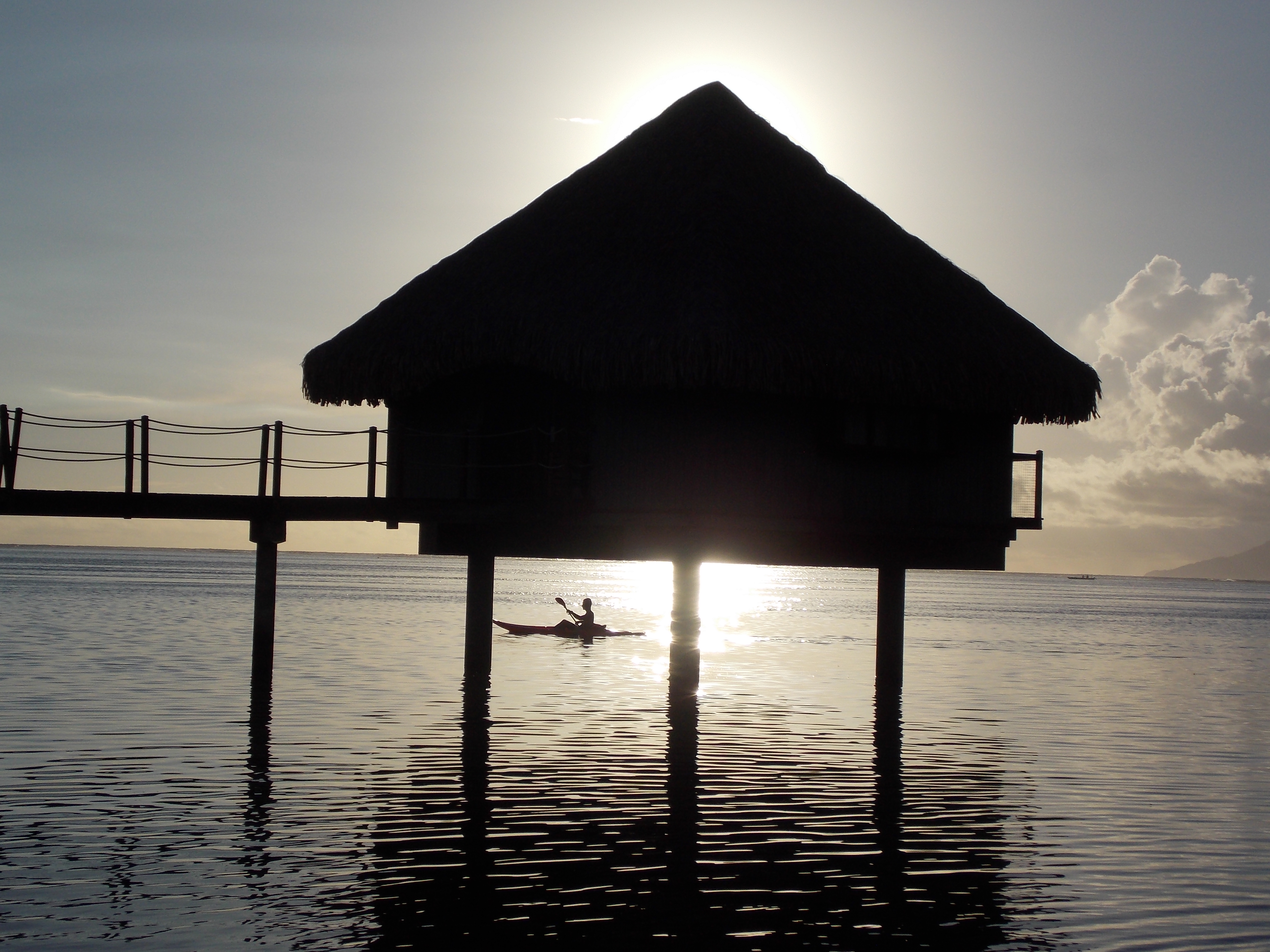
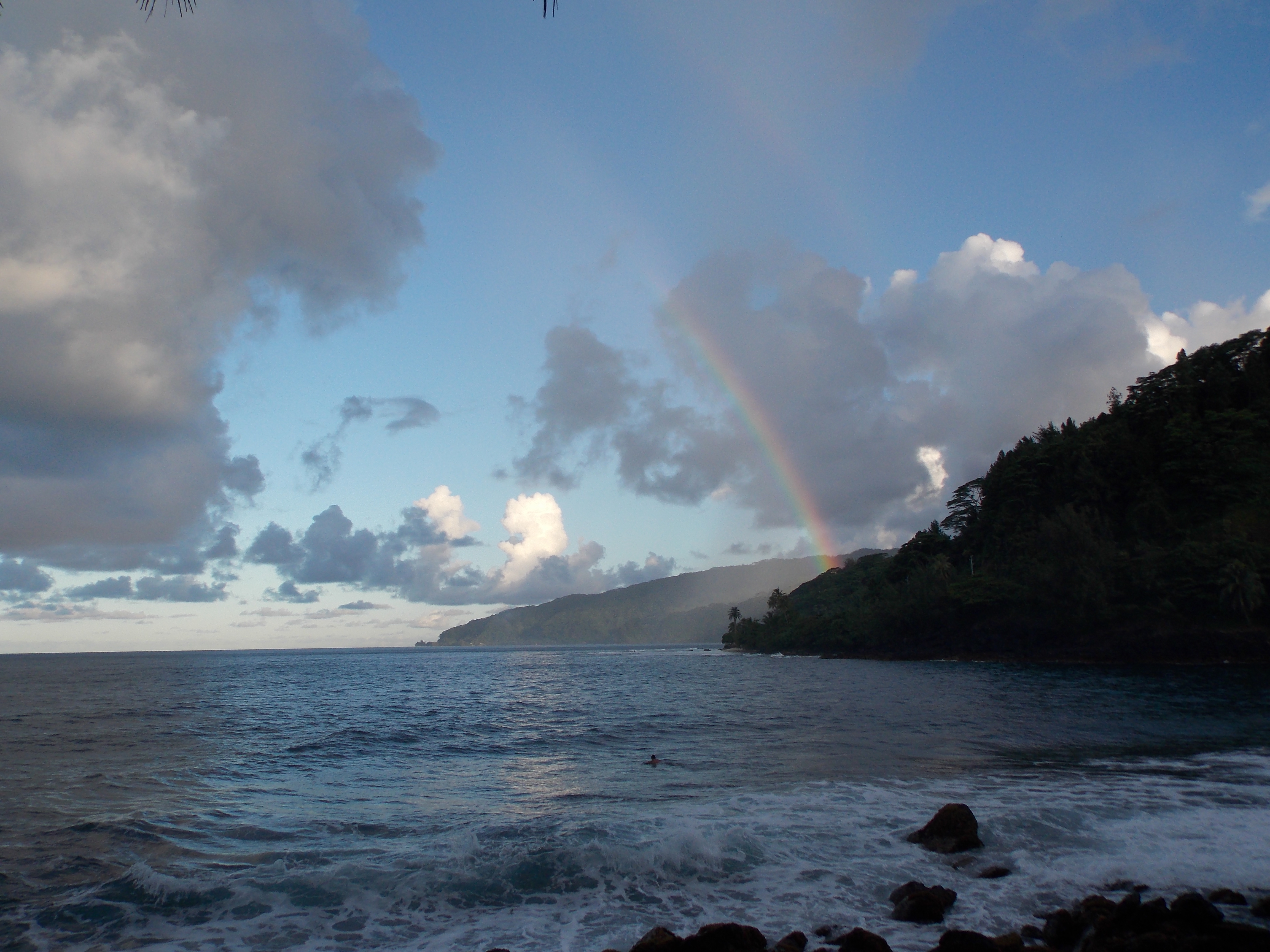
And on the day of my red eye departure I rented a kayak and cruised the half-mile or so out to the barrier reef that encircles 75% of Tahiti. The water in the lagoon created by the reef was crystal clear; where it looked to be a foot deep I knew it was ten. From out by the reef I could look back and see how mountainous Tahiti really is, and the darker clouds ensheathed the higher peaks as if protecting the secrets of the gods. It was beautiful and so unbelievably tranquil, as being on the water always seems to be.

In truth, I found Tahiti to be just the island paradise I’d always envisioned; a lot like Hawaii, just further away and so very … comment le dites-vous? … French. I doubt I’ll be back this way again, but I’m glad I was here once.

DSCN2591

Categories: Uncategorized

Due to circumstances beyond our control …

I had a post ready to go from Tahiti but the signal in the hotel was too weak to download photos, and Tahiti without pictures didn’t make much sense. The Internet situation is even worse here on Easter Island, so I’ll be combining them into one post when I get to Santiago this weekend. But all is well out here in the middle of the Pacific.

I hope everyone has a great Easter weekend!


Categories: Uncategorized

Vietnam

NOTE: I’ve tried to be responsive to those who have requested “fewer words, more pictures”, but fair warning: this one kind of got away from me.

On the evening of December 1, 1969, some bureaucrat in Washington pulled birthdays out of a jar and decided the collective fate of hundreds of thousands of young men, including me. This was the first Draft Lottery for military induction for the Vietnam War, and as college seniors about to graduate my classmates and I were the most vulnerable. It had been reported that people with birthdays picked in the first 120 were certain to be called up, and those in the second 120 were on the fence; if you were number 240 to 366 you would be safe. (That proved to be accurate, as 195 was the last number called to induction.)

It was difficult to breathe as they started announcing birthdays. My fraternity brother Bob Hepler was number 10, and somewhere he found some fatigues and a toy machine gun and spent the rest of the night ambushing people in the hallway. I made it to 120, a big milestone, and then 200, then into the “safe zone” with 240, and then 300. And finally: “Number 301, June third.” Most of my closest friends were similarly fortunate, but it was impossible to celebrate knowing that fate had been far less kind to so many others.

A thousand times I’ve wondered why I was so lucky. A thousand times I’ve asked myself what I would have done if I’d been number 1 or 3 instead of 301. It gives me chills to think about what might have happened if not for being so outrageously lucky the night they pulled our lives out of a jar.

So now I find myself with a travel itinerary that includes Saigon, the Mekong River, Da Nang, Hanoi, place names that bring back horrific images, not to mention quite a bit of guilt. I know Vietnam has changed dramatically in the past 30 years, but it’s hard to think of it in any other context but that war. I’m curious about how I will feel by the time I leave.

Saigon

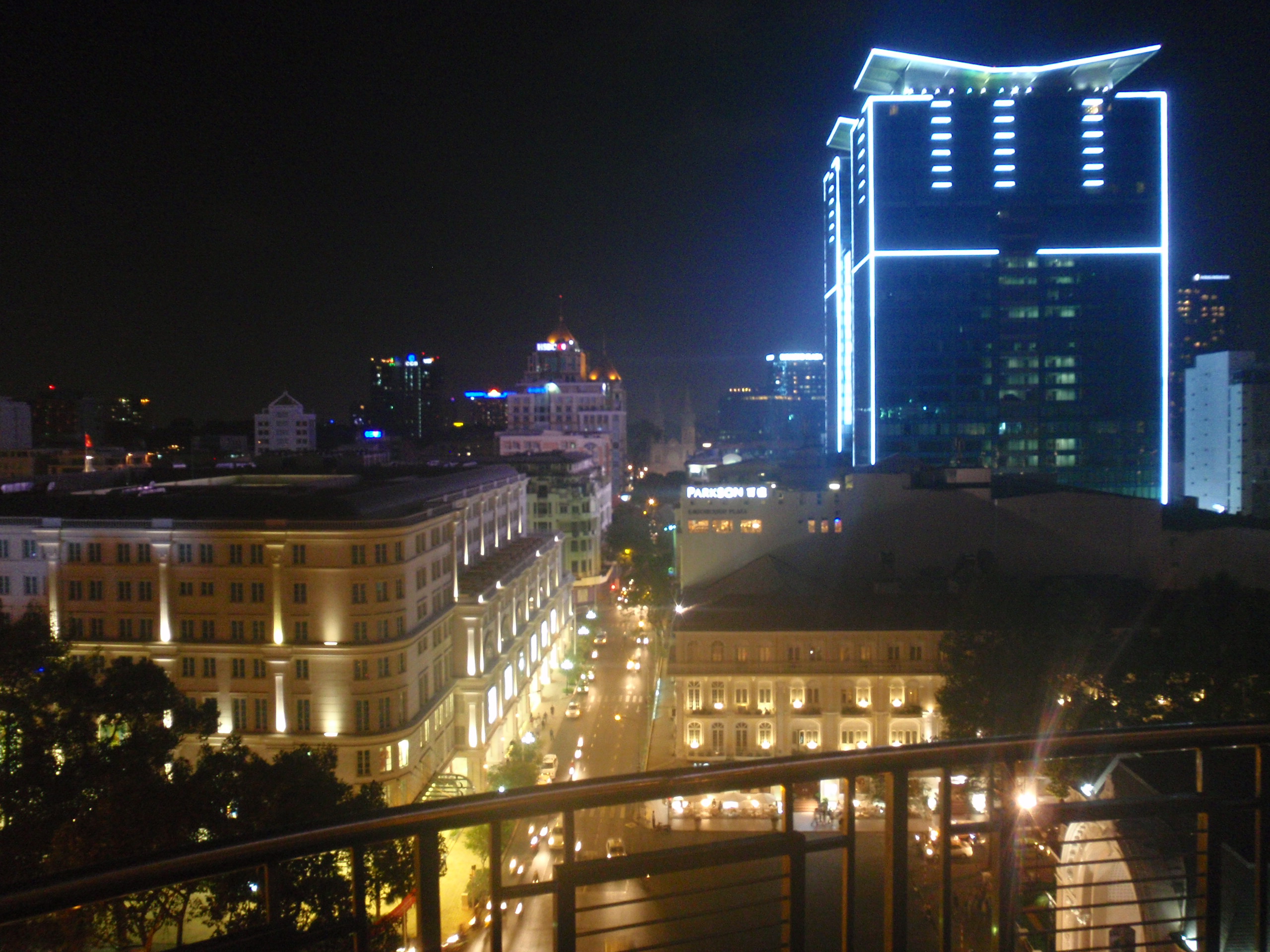
We flew into Saigon from Cambodia at night and realized on the bus ride from the airport that it has become a vibrant, modern city. (Since 1976 it has officially been known as Ho Chi Minh City, but if you don’t mind I’ll stick with the name that is less political, more familiar and easier to type). The roads were wide and smooth, the skyline gleaming with glass and colorful lights.

View of modern-day Saigon from the Saigon Saigon bar.

View of modern-day Saigon from the Saigon Saigon bar.

In April of 1975 Saigon had fallen to the National Liberation Front of North Vietnam, marking the end of the Vietnam War and the beginning of the unification of Vietnam into the communist republic that it is today. The fall of Saigon was punctuated by one of the largest helicopter evacuations in history, as remaining American civilians and military personnel were airlifted off the roof of the American Embassy, the sad culmination of a futile war we couldn’t win.

Fish farms in the middle of the Mekong River.

Floating fish farms in the middle of the Mekong River.

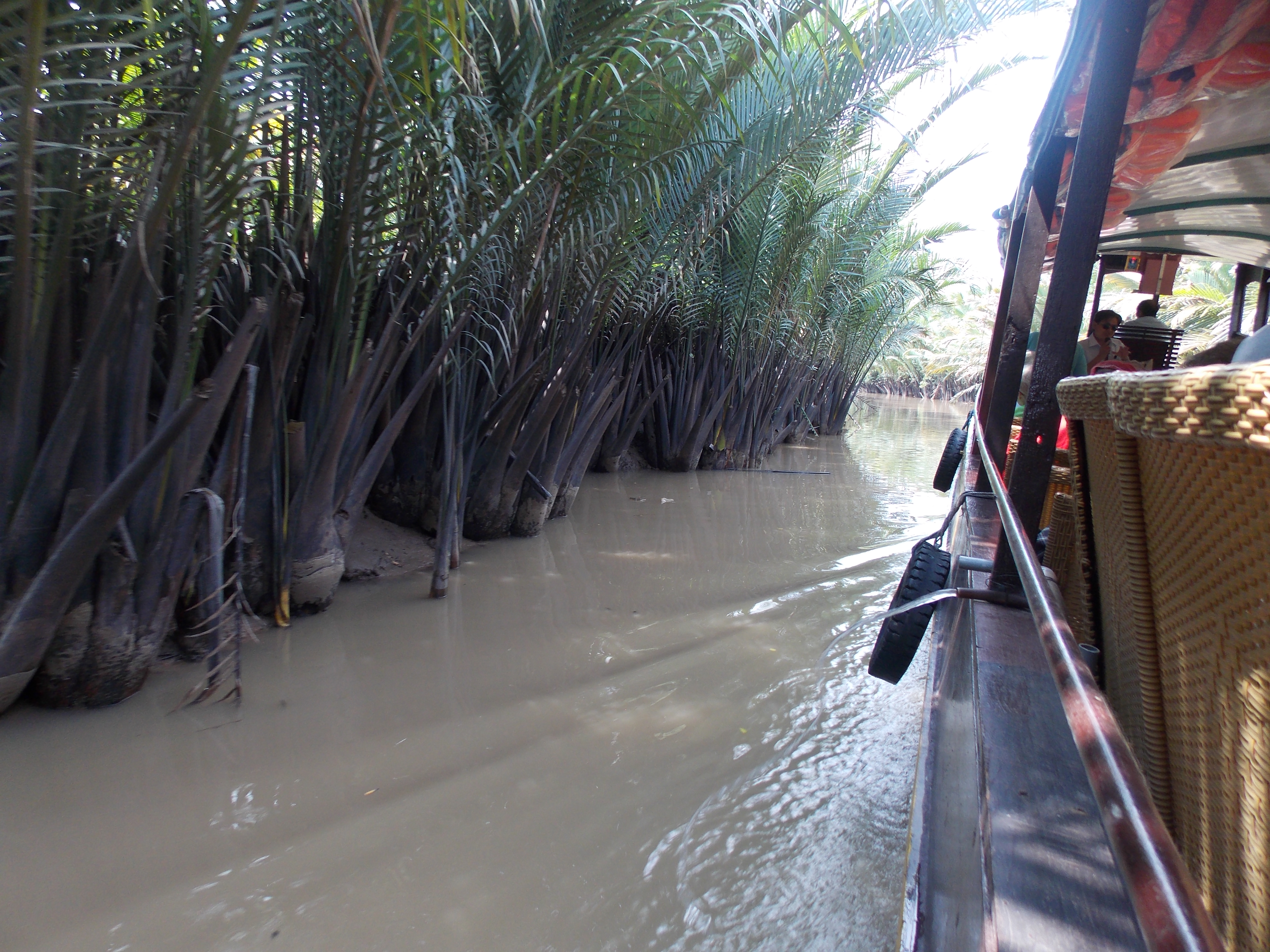
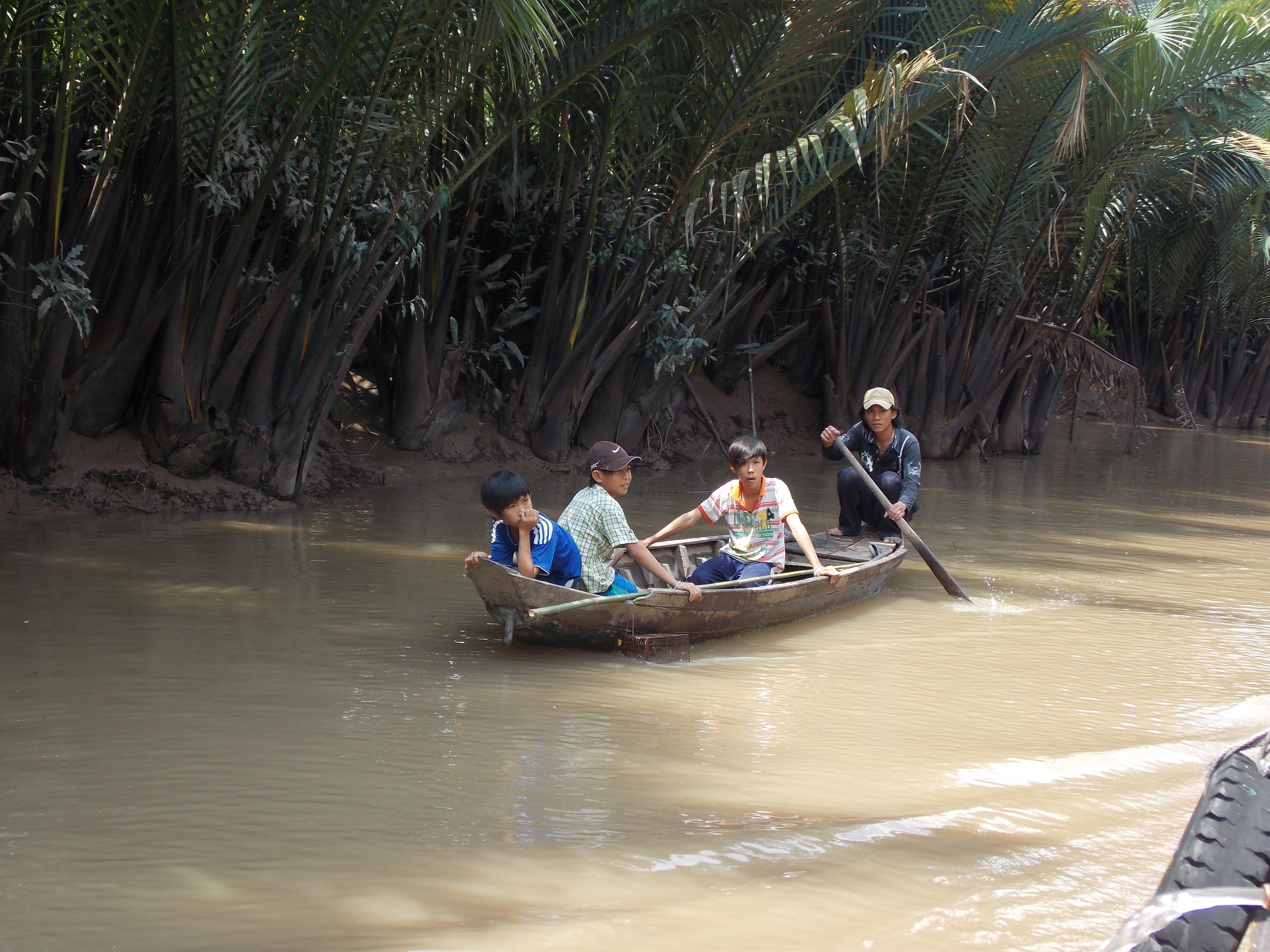
Our first morning we got into a boat on the Mekong River, passed by the floating fish farms, entered a narrow tributary and headed to an island where natives lived and made coconut candy and sold fruits and bottles of liquor with scorpions and small cobras inside. And you thought the worm in a bottle of tequila was disgusting!

DSCN2242As we motored our way up the tight passage at low tide, with barely enough room for another boat to pass and thick jungle on either side, it was impossible to shake images of young soldiers slogging through booby-trapped rice paddies, or scenes from films; Martin Sheen and his crew of hopped up river cowboys heading into the heart of darkness in Apocalypse Now.  It was unsettling. But the people we visited were happy, they played music for us and sang, gave us tea and fruit, and it seemed genuine.

That night I took a cab to the Caravelle Hotel and a rooftop bar called Saigon Saigon, where the journalists and photographers used to hang out during the war. Other than the cynicism that soaked into the dry wall I’m sure nothing remains from that era; the bar is modern and neon-lit, and the 270-degree view is of beautiful hotels and high-rise office buildings and condominiums. I sat on the patio enjoying the scene and trying to imagine what it was like with all these correspondents sitting around bitching about being spoon-fed their stories. I ran into some friends from the tour and we had a few drinks and listened to a terrific band from Cuba, which we assumed was part of some communist cultural exchange program.

The most compelling segment of our southern Vietnam portion of the trip was a visit to the Cuchi tunnel complex, about 50 kilometers northwest of Saigon. It is a 180-mile system of tunnels that were originally constructed in

Hidden tunnel entrance.

Hidden tunnel entrance.

1948 and used to fight the French, and since they were made of solid sandstone, requiring no timber support, they were still functional 15 years later. Because they were close to the infamous Ho Chi Minh Trail they were easy to supply, and they were ideal for the Vietnamese “hit and run away” style of fighting, according to our guide. This was an area that the American GI’s sardonically called the “Happy Triangle”; of the 58,000 American soldiers killed in Vietnam, 11,000 were killed here.

Before touring the complex we watched an old and poorly made film that was shockingly anti-American. “The poisonous bombs of America destroy the peaceful beauty of village life,” said the narrator at one point. “Like a crazy batch of devils they fired into schools, pots and pans.” The film referred to the communist “liberators” as American Killer Heroes. It was disturbing on many levels, not the least of which is that this is clearly how people around here feel, to this day.

The Viet Cong slept in the well-hidden tunnels by day and at night, when the Americans were back in Saigon “partying” (so said our guide), the VC would get to work expanding the tunnel complex, installing their booby traps, building their weapons. We saw the secret tunnel openings, a board maybe 10” by 15” that was

Revolving-door booby trap.

Revolving-door booby trap.

undetectable when covered by leaves. We saw many examples of bobby traps using spikes made of steel or bamboo. Within the cave system were kitchens with ventilation, clothing depots, and weapons-making areas.

We crawled through 60 meters of tunnel, very uncomfortable and claustrophobic, but this was a sanctuary for the enemy in this area for many years. We began to see clearly why this had been such a challenging opponent to confront. I hadn’t realized that Vietnam had had such a prolonged and difficult war with France, and how that had served as preparation to fight the Americans. They had it down to a science.

In that fascinating complex of hidden tunnels and booby traps, there were lessons all around us.

My time in Cambodia and Vietnam was part of an organized tour with a company called SmarTours. It is the only multi-day tour I’ve done so far; I have one more scheduled in Mexico, touring the Mayan ruins. The tour itself was a mixed bag … we stayed in excellent hotels and covered a lot of ground, but the forced shopping opportunities got old in a hurry. But what makes or breaks a tour like this is the people, and we had a terrific group of very nice people and very experienced travelers; if Cambodia and Vietnam have moved to the top of your list, you have probably been a lot of places! So it was fun getting to know these folks (all American and Canadian) and learning about their past trips and favorite spots. I look forward to staying in contact with many of them.
OLYMPUS DIGITAL CAMERA

Hoi An

We spent several days in the coastal central part of Vietnam, flying into Da Nang and taking a bus to Hoi An, and there was universal agreement that we would liked to have stayed there longer. There is not much to say about it historically, other than it was originally populated by Chinese who came to escape from politics and stayed to set up businesses. Fifteen years ago it was dead but now it is starting to boom.

DSCN2278

It’s a very peaceful place on a nice river and a short ride from the sea and excellent beaches. There were great shops, good restaurants, cooking classes, bike rides, silkworm demonstrations, inexpensive silk tailoring, a fascinating central market and Japanese bridges, and our excellent hotel was a short walk from all of this. Three of us had a wonderful dinner at an Italian Restaurant called “Good Morning Vietnam”. Hoi An was very comfortable and livable, a place to return to.

Hoi An night scene.

Hoi An night scene.

The currency in Vietnam is the dong. And it’s very small; one U.S. dollar equals more than 20,000 Vietnamese dong. If you want to purchase anything of real value, boy, you sure need a lot of dong. 

Da Nang

We heard this city’s name often during the war and with good reason; it was home to a major air force base that at one point averaged more than 2,500 air traffic operations daily, more than any other airport in the world. One of the women on our tour was a flight attendant who made many trips into Da Nang to evacuate wounded soldiers.

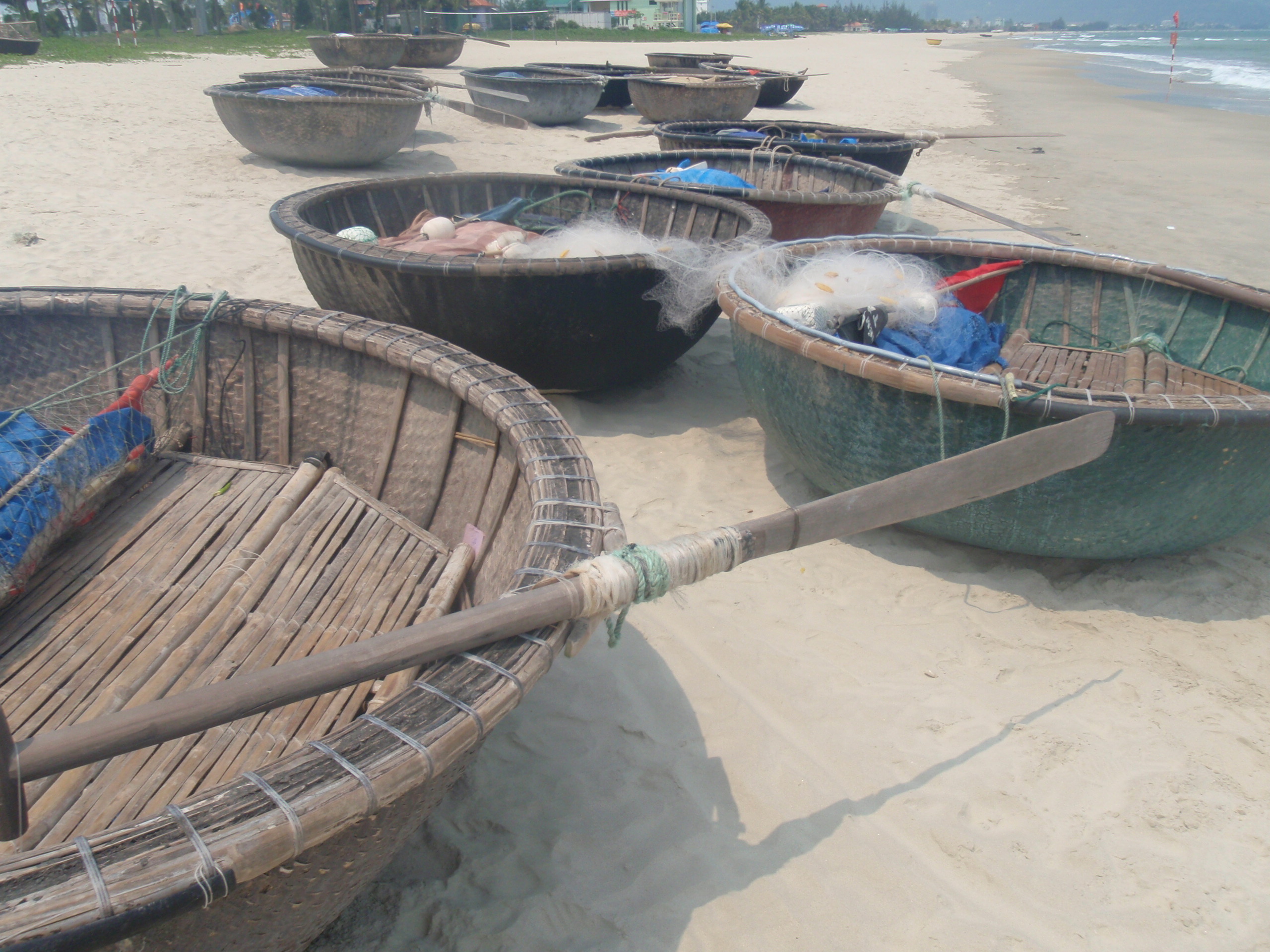
Fishing boats on China Beach.

Fishing boats on China Beach.

Today it’s a thriving port city on the South China Sea, the commercial and cultural hub of central Vietnam. We drove around a bit and had lunch at a restaurant overlooking China Beach, originally My Khe Beach but renamed by American and Australian soldiers. There was a TV series for a few years about a hospital there that prepared the wounded for evacuation. After lunch we walked on the beach and saw many unusual, round, one-man fishing boats made of bamboo, and tried to converse with a fisherman who was mending his nets in one of them. It was a pleasant interlude before heading off to …

Hue’

Hue’ (hway) was another familiar name.  In the Tet Offensive of 1968 it was damaged severely by American bombing and traumatized by a brutal massacre committed by communist troops. Many of the historical buildings that were destroyed are just now being restored. We had a wonderful guide in central Vietnam, a young mother of two named Ha (“every time you laugh you say my name”), and as a native of Hue’ with many family members impacted by the war, she had particularly vivid descriptions.

“In 1968, no one knew who to trust. People just disappeared. There was so much killing and bombing it was easy to kill someone you didn’t like. Many were scared and escaped to the north. People couldn’t find their family members, their brothers, their husbands. They put all the dead into big graves, and the fortune tellers, the people who communicate with ghosts, they couldn’t find a specific person with so many souls crowded together.”

Inside the Imperial Palace in Hue'.

Inside the Imperial Palace in Hue’.

The main attraction in Hue’ is the massive complex that includes the Citadel, Imperial Palace and Forbidden City. The city had been the capital of the country from 1802 to 1945 and this is where the royal family had lived, but it suffered during a war with the French in 1947 and in 1968 was a Viet Cong stronghold and was heavily bombed. Little by little it is being restored, but there is a long Hue’ to go.

Ha Long Bay

We headed north, taking a flight from Hue’ to Hanoi and a bus to our hotel on the coast. In the morning we took a four-hour boat trip to Vietnam’s premier attraction, its Angkor Wat: Ha Long Bay.

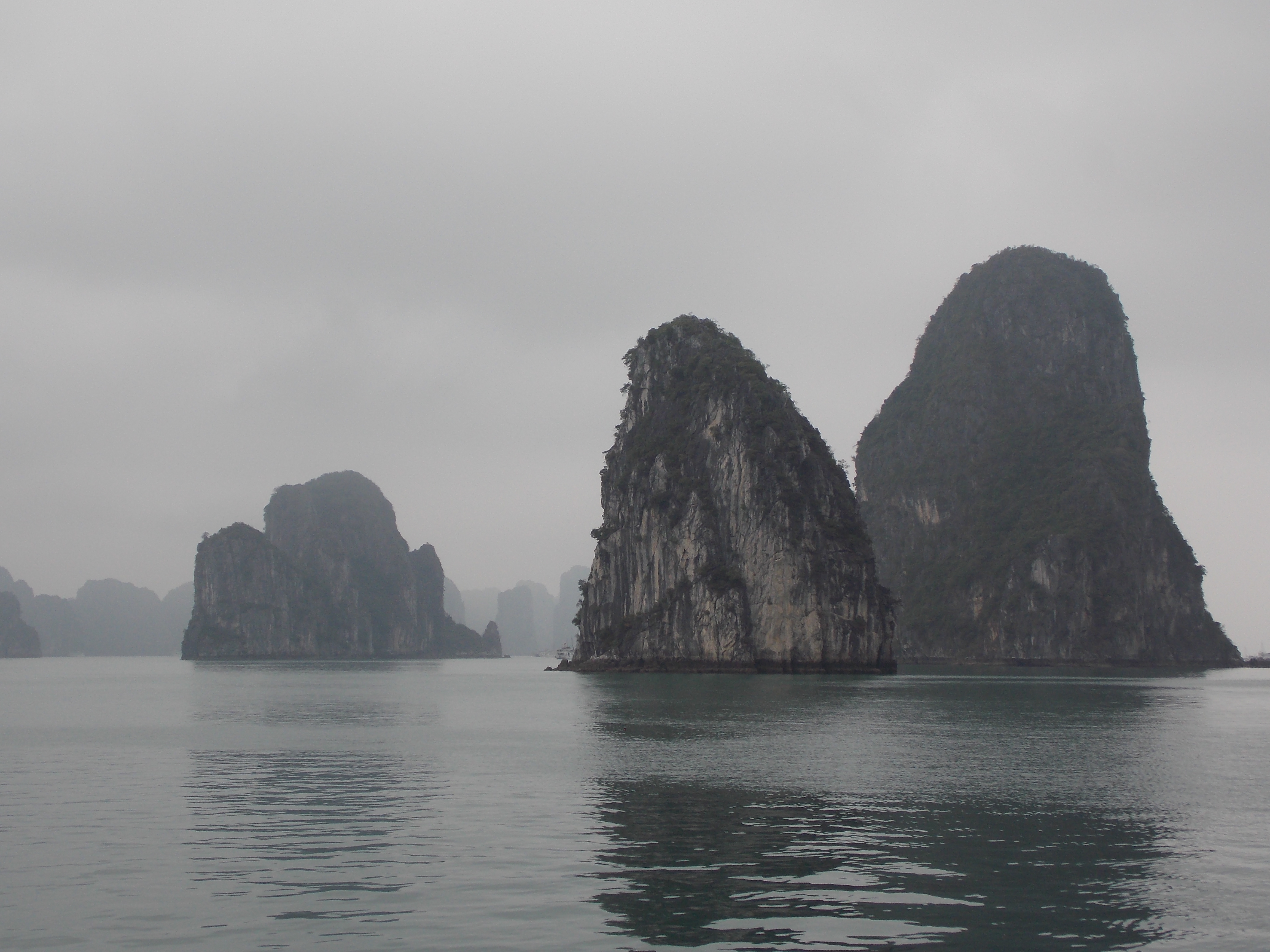
We were told that 500 boats per day take people to explore the mysteries of Ha Long Bay.

We were told that 500 boats per day take people to explore the mysteries of Ha Long Bay.

Ha Long (“descending dragon”) Bay is a series of more than 3000 islands and limestone rocks cropping up from the Gulf of Tonkin near the port city of Haiphong. Millions of years of tectonic activity created underwater mountains that ultimately surfaced. It reminded some of our world travelers of the Galapagos, and others of Antarctica. We had a lousy weather day in terms of seeing great distances, but the mist and light rain did create an atmosphere that somehow seemed appropriate.

DSCN2451

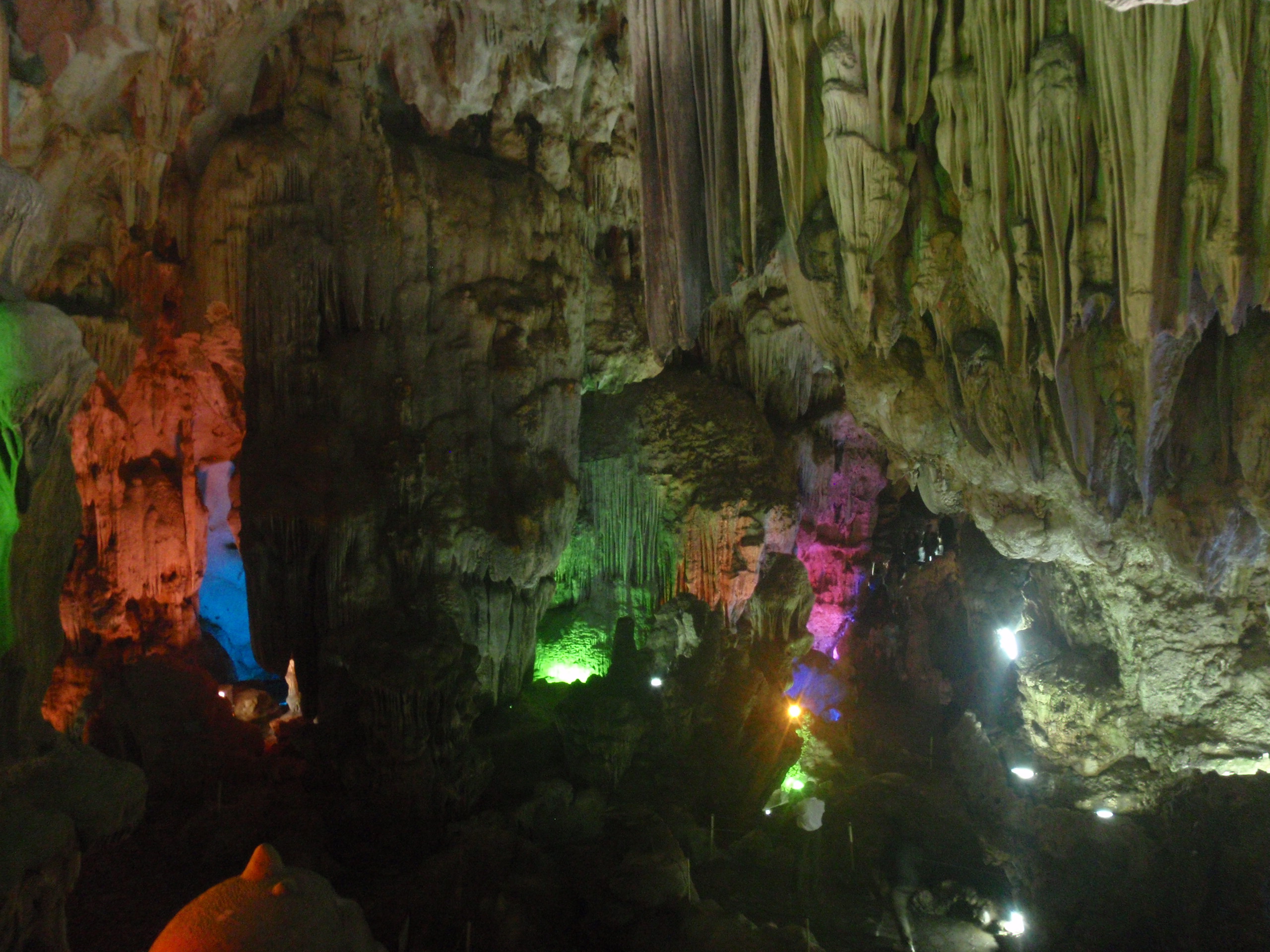
The rocky coastline of the islands contains many caves and grottos, and we visited one that was only discovered in 1993. They call it “Heaven’s Palace”, and it was huge and surprisingly spectacular. We anchored out after that and had a wonderful fish lunch, and then headed for our final stop on the tour.

"Heaven's Palace" ... or was it "100 Steps to Beauty"?

“Heaven’s Palace” … or was it “100 Steps to Beauty”?

Hanoi

Hanoi is very different from Saigon and not as appealing at first, but it kind of grows on you. Whereas Saigon is new and shiny, Hanoi is more ancient and gritty. In some areas there is a substantial European flavor from the days of French occupation, particularly with some of the larger government buildings. People seem to live on the street here, sitting in small plastic chairs, cooking on their street grills, buying food from the impossibly tiny women who carry the Asian scales of justice on their shoulders filled with vegetables and rice and cans of cola and beer.

DSCN2482

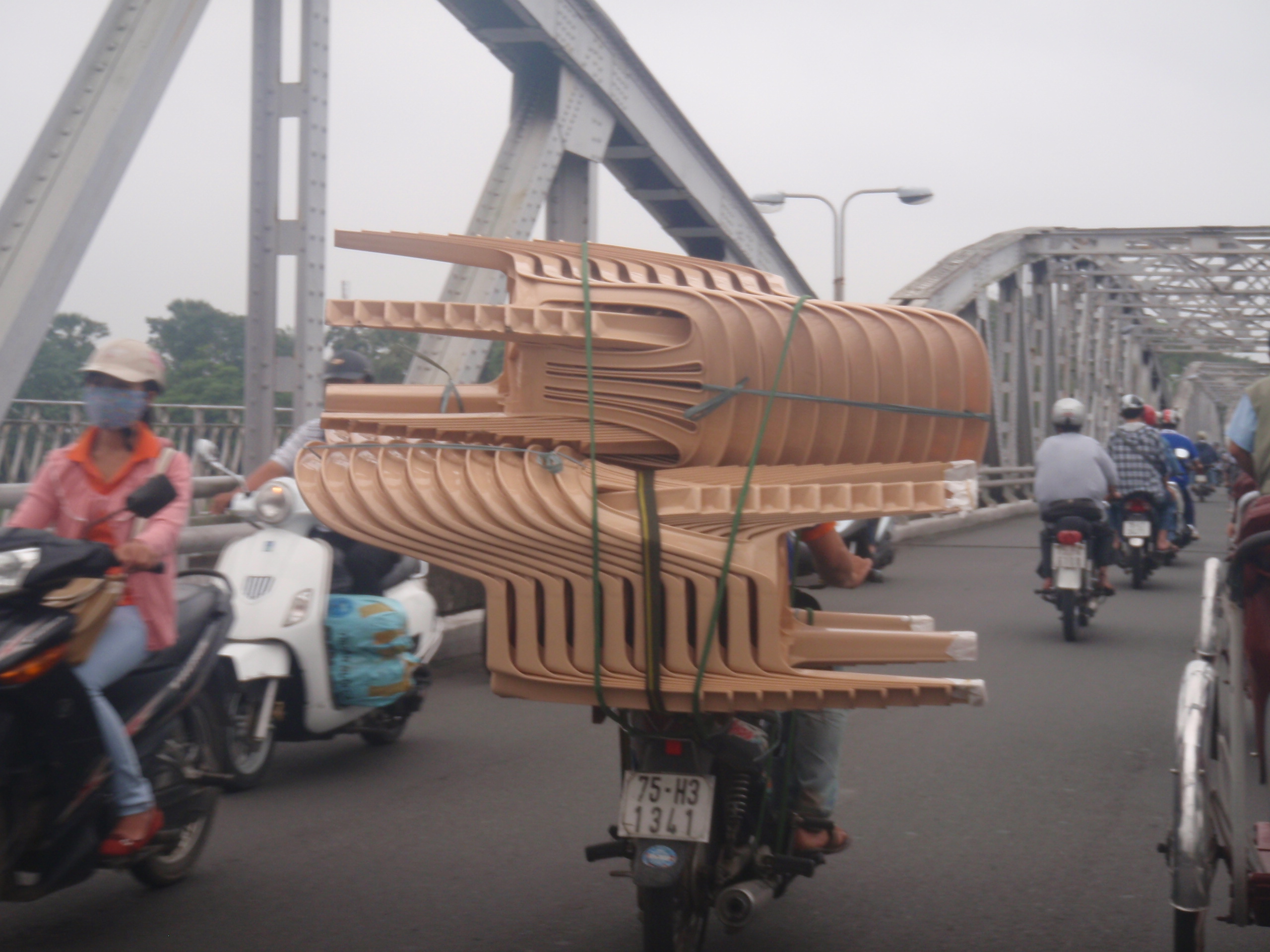
There are nine million residents of Hanoi, and 6.5 million motorbikes, an infestation greater than anywhere I’ve seen in Africa, India, Nepal, Thailand, Cambodia or southern Vietnam. The sidewalks are often impassable because of all the motorbikes parked there, and they must comprise 90% of the vehicles on the street. They drive up over the curb, cut across lanes of traffic, use their maneuverability to creative advantage at every turn. At some intersections there are no signals of any kind so they just proceed toward each other with awareness and weave a tapestry of traffic.

We had a very odd experience visiting Ho Chi Minh’s mausoleum. It is clearly a major shrine for Vietnamese people and there was a long line to get in. There are a lot of rules: shoulders covered, no hat, no talking. As I entered the room where he lays I was walking with my hands respectfully clasped behind my back, and a guard hissed at me and indicated that I had to hold my hands at my sides. I was channeling my inner John McEnroe (“you can’t be serious!”) but I complied instead. It was a pretty good you’re-now-in-a-communist-country moment.

The Ho Chi Minh mauseleum

The Ho Chi Minh mausoleum.

“Ho”, as we were fond of calling him, was looking pretty good. It turns out he wanted to be cremated but the Politburo boys at the Kremlin know a promotional opportunity when they see one and had him embalmed with the same process they used on Lenin. Ho is on display every morning from eight to eleven, and then he goes back to the freezer. Each year he gets a two-month vacation back in Russia for re-embalming, a spa treatment I’m sure none of us can afford.

In the northern part of Vietnam people do eat dog. I’m a big “when in Rome” guy so I made a reservation at the acclaimed Restaurant de Chien (the French influence remains in Hanoi), and to get a flavor for different breeds I ordered the “ngot nuang”, the Pooch Sampler. The grilled Schnauzer with sauerkraut was a casual appetizer that would enliven any tailgate party. The Poodle au Poivre was cooked to perfection, but the hollandaise sauce was a bit on the rich side. I caught a nice little buzz from the poppyseed seasoning on the ground Afghan hound. But my favorite, unquestionably, was the Chihuahua enchilada, so zesty with just a hint of jalapeno.

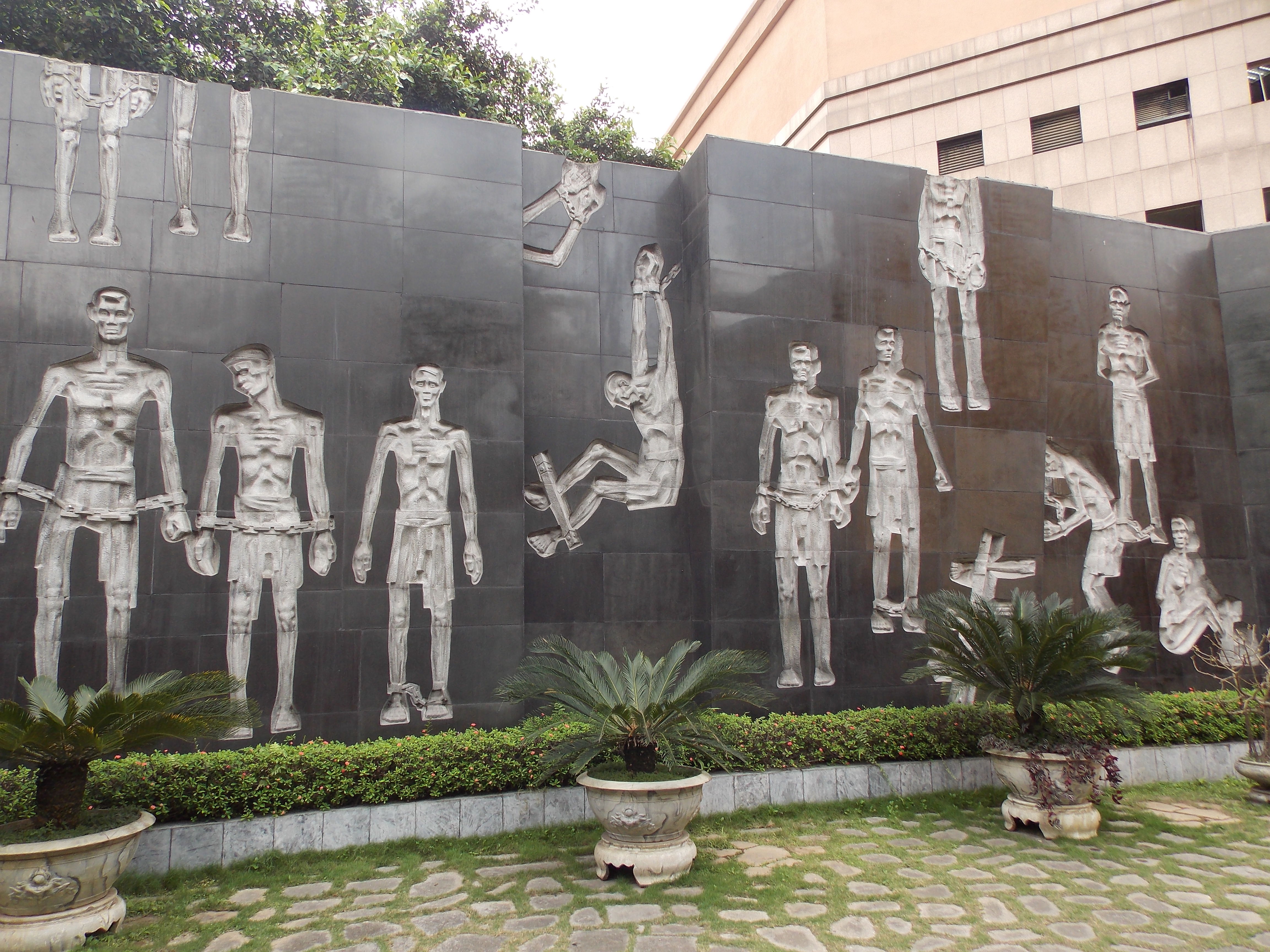
We saw other things in Hanoi, including a charming and unusual water puppet show, but nothing was as impactful for all of us as a visit to the Hoa Lo prison, known during the war as the Hanoi Hilton.

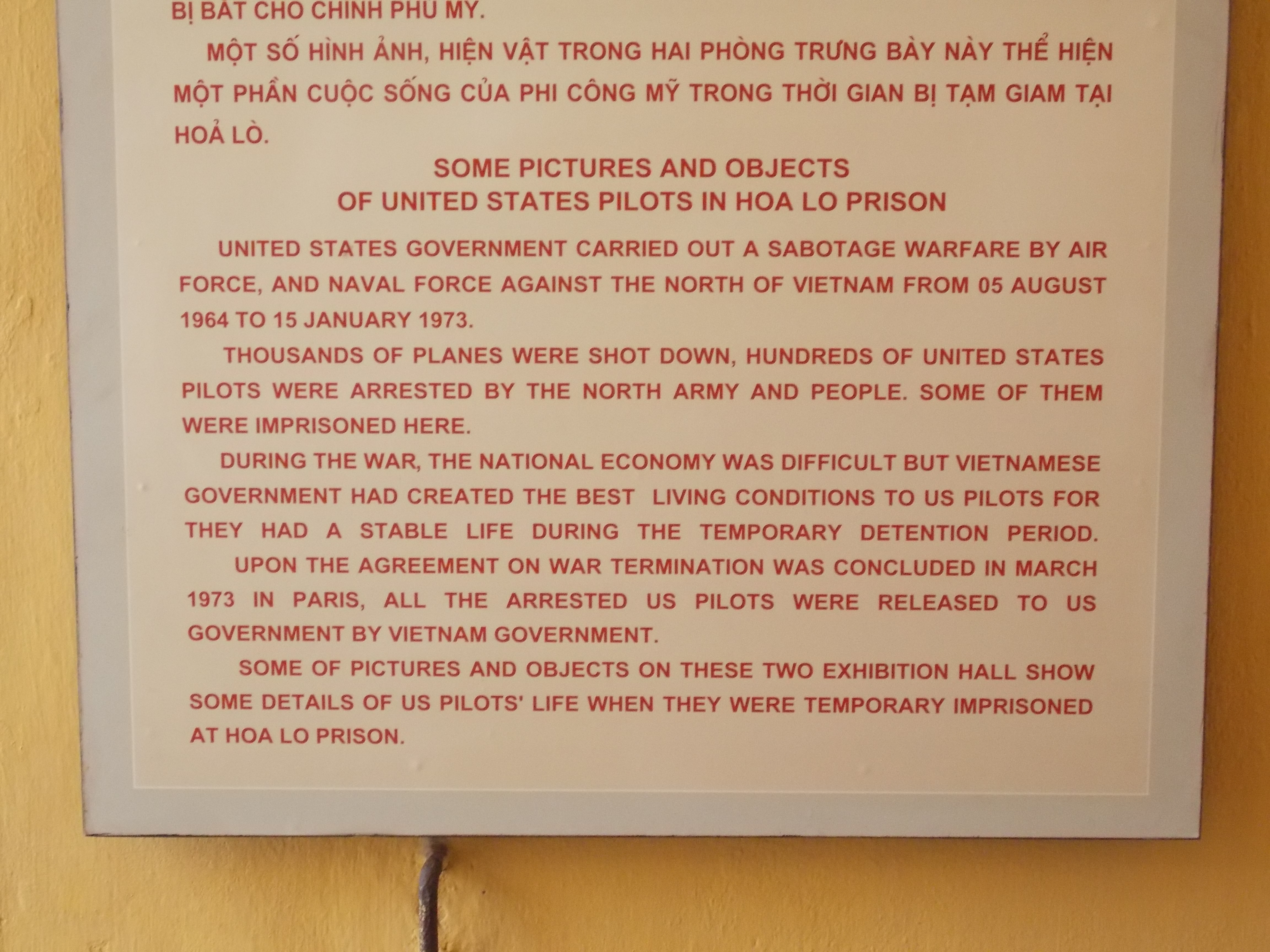
For many years this prison was used by the French to incarcerate Vietnamese resistors to French occupation, and then the Vietnamese used it to imprison American pilots who were shot down in the 60s and early 70s. Once again, it was odd and uncomfortable being on the other side of the propaganda, but also enlightening.

Image on the wall of the infamous Hanoi Hilton.

Image on the wall of the infamous Hanoi Hilton.

We call it the Vietnam War, but here they call it the American War. Their effort was called the “Anti-U.S. Resistance”. The videos on exhibit in the prison emphasized the American bombing of schools and hospitals, of civilians. The displays lost credibility when they showed how well the American prisoners were treated despite; there were videos and photos of the pilots playing volleyball, eating well, getting medical treatment (included was a photo of John McCain), enjoying Christmas celebrations and packages from home. We knew this was all a long way from the truth.

I wonder what the imprisoned American pilots would have to say about this?

I wonder what the imprisoned American pilots would have to say about this?

But there is also no denying that almost 60,000 young Americans died needlessly, and that the lives of hundreds of thousands who returned were contorted irrevocably. And there is no denying that more than one million Vietnamese soldiers were killed, north and south, not to mention between two and three million Vietnamese civilians, and that the chemicals used will impact generations yet to come.

And for what? To prevent the spread of communism? Vietnam is a communist country today, albeit a hybrid that allows its citizens to open businesses and be entrepreneurial. And how many of the surrounding countries has communism spread to? None. True communism in the form that spawned McCarthyism, the progenitor of this war, cannot succeed, nor can any religion or ideology that sucks the spirit out of its people by stifling creativity and free expression.

So I leave Vietnam no longer feeling guilty about having a high lottery number. I do leave with a much clearer sense of how misguided we were, how impossible it was to accomplish anything but mass devastation. I leave feeling angry that the country I love so much could be responsible for a calamity of such magnitude … and that we haven’t seemed to learn from it! If I feel guilty about anything now, it’s that I didn’t protest loudly enough at the time.
But in our hotel bar in Hanoi the most sensible approach was articulated by a veteran of the war from Australia, in Vietnam with five of his fellow vets for the first time in forty years. “Everything here is so much different now, mate,” he said. “We’ve all learned that it is finally time to put that chapter behind us.”

DSCN2240

OLYMPUS DIGITAL CAMERA

OLYMPUS DIGITAL CAMERA

Categories: Uncategorized

Siem Reap and Angkor Wat

From Phnom Penh it was a seven-hour bus ride north to Siem Reap, which is home to the great Angkor temple complex and the reason most people come to Cambodia.

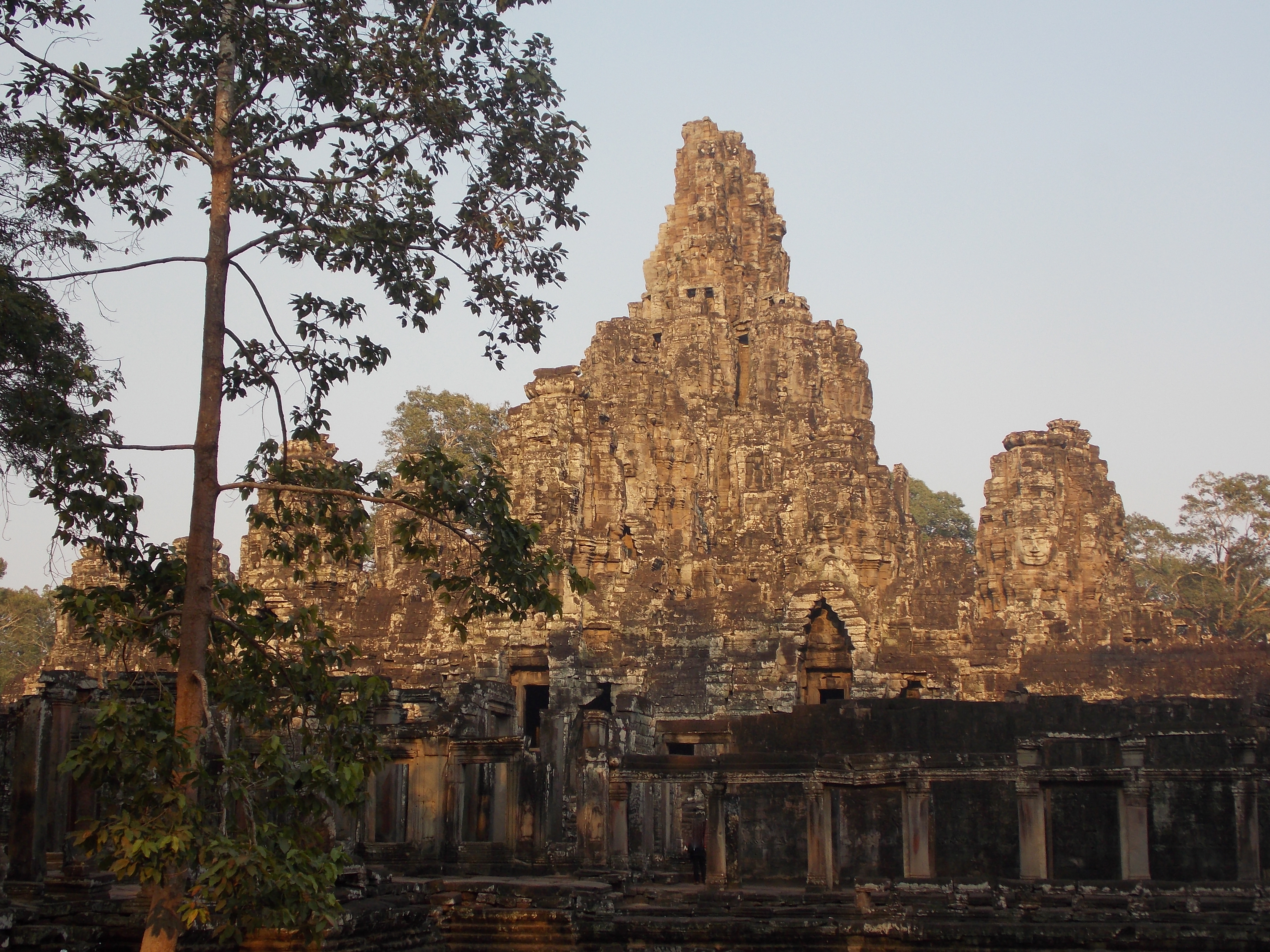
Rocks, ruins and rubble.

Rocks, ruins and rubble.

According to Wikipedia, in 2007 an international team of researchers using satellite photographs and other modern techniques concluded that Angkor had been the largest preindustrial city in the world, at least 390 square miles and supporting up to one million people. Its closest rival, the Mayan city of Tikal in Guatemala, was no more than 58 square miles in total size. In its glory Angkor contained more than 1000 temples, the oldest dating back to the 6th century; ruins that remain today are from between the 9th and 12th centuries. It served as the capital of the Khmer Empire from the 9th to 14th centuries, but in the 15th century an Ayutthayan army from Siam captured Angkor, driving the population south and destroying the city. The capital was moved to Phnom Penh and the massive Angkor complex became deserted and overgrown.

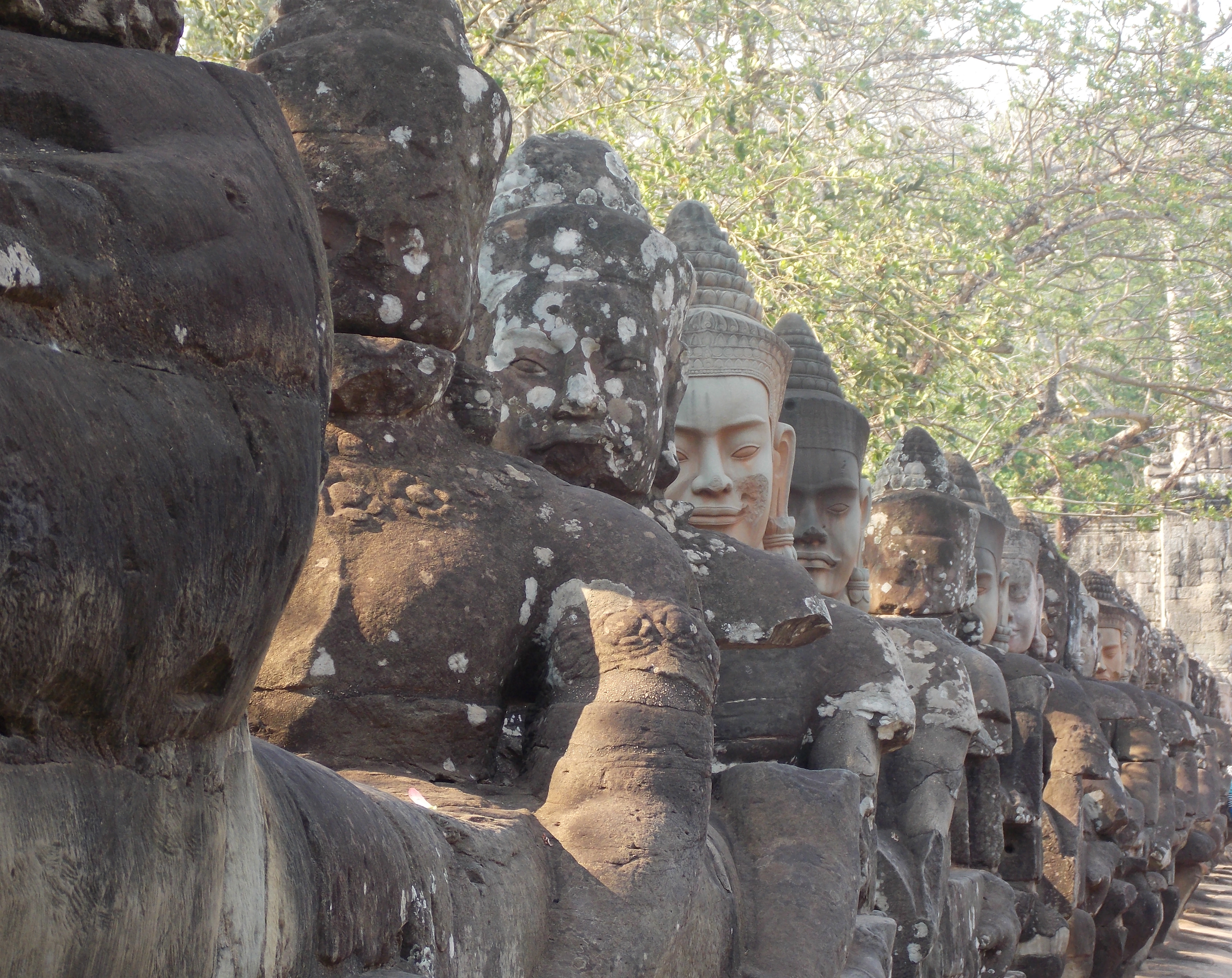
The entrance to Angkor is lined with gods and demons.

The entrance to Angkor is lined with gods and demons.

The story has it that a Frenchman, with guidance from a local monk, rediscovered Angkor in 1860. I did overhear one guide say this: “He didn’t rediscover it, he just re-publicized it. It had been here all along as home to monks, and many Japanese and Chinese and Vietnamese people knew it was here.” But I prefer imagining this guy and his monk buddy hacking their way through the jungle with machetes and stumbling upon these incredible temple ruins, in the ultimate Indiana Jones moment.

The many faces of Angkor Thom

The many faces of Angkor Thom

The first afternoon we visited the ruins of Angkor Thom, “Big City”. In its day it was three square kilometers, with a 12-kilometer moat and 57 towers. The ruins are quite striking and there are areas where the stone is much lighter because the Japanese government has paid for restoration. There are faces built into the stones, and a prevalent theory is that they are a combination of the stern visage of the king who built the temple and the benevolent face of Buddha.

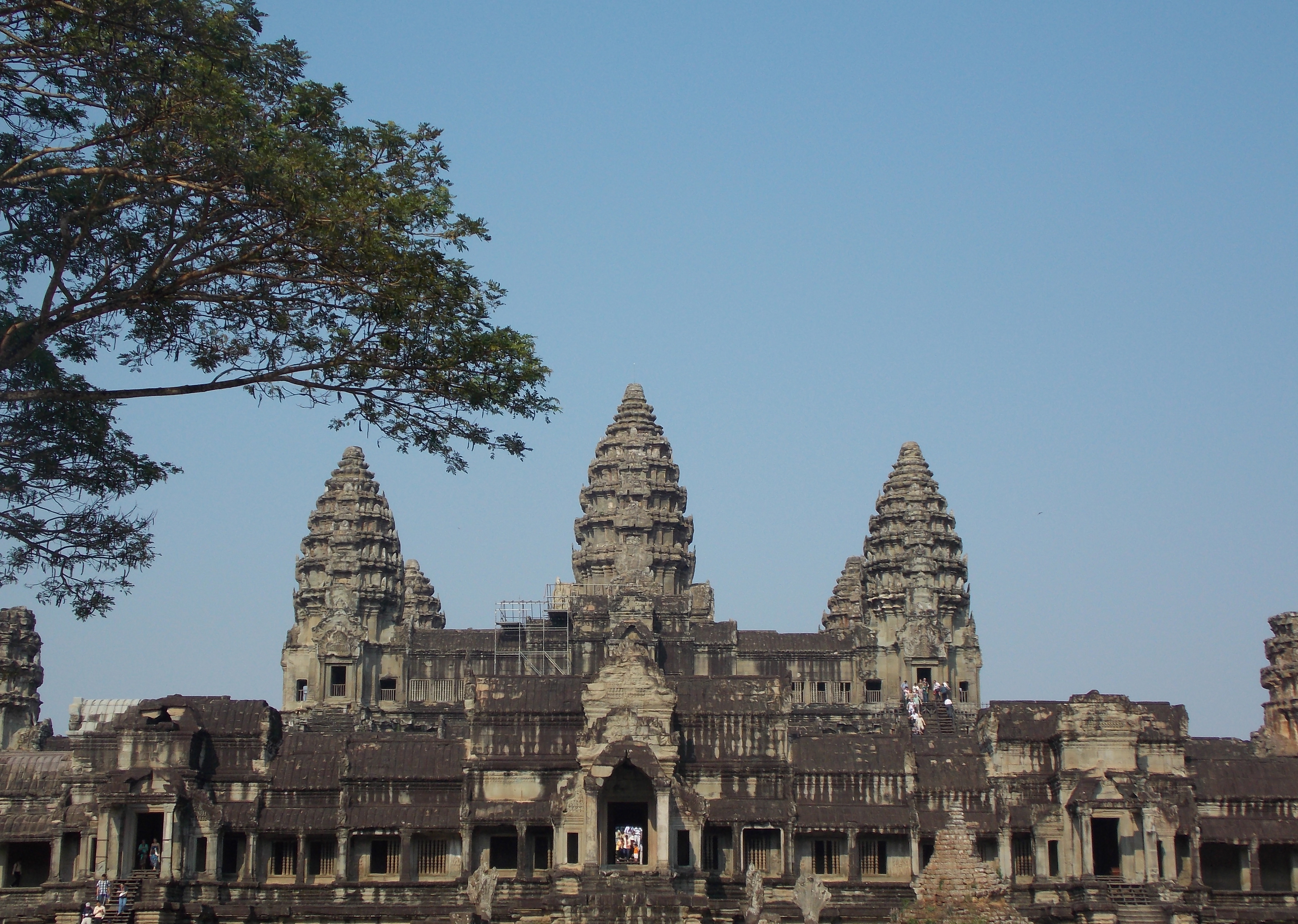
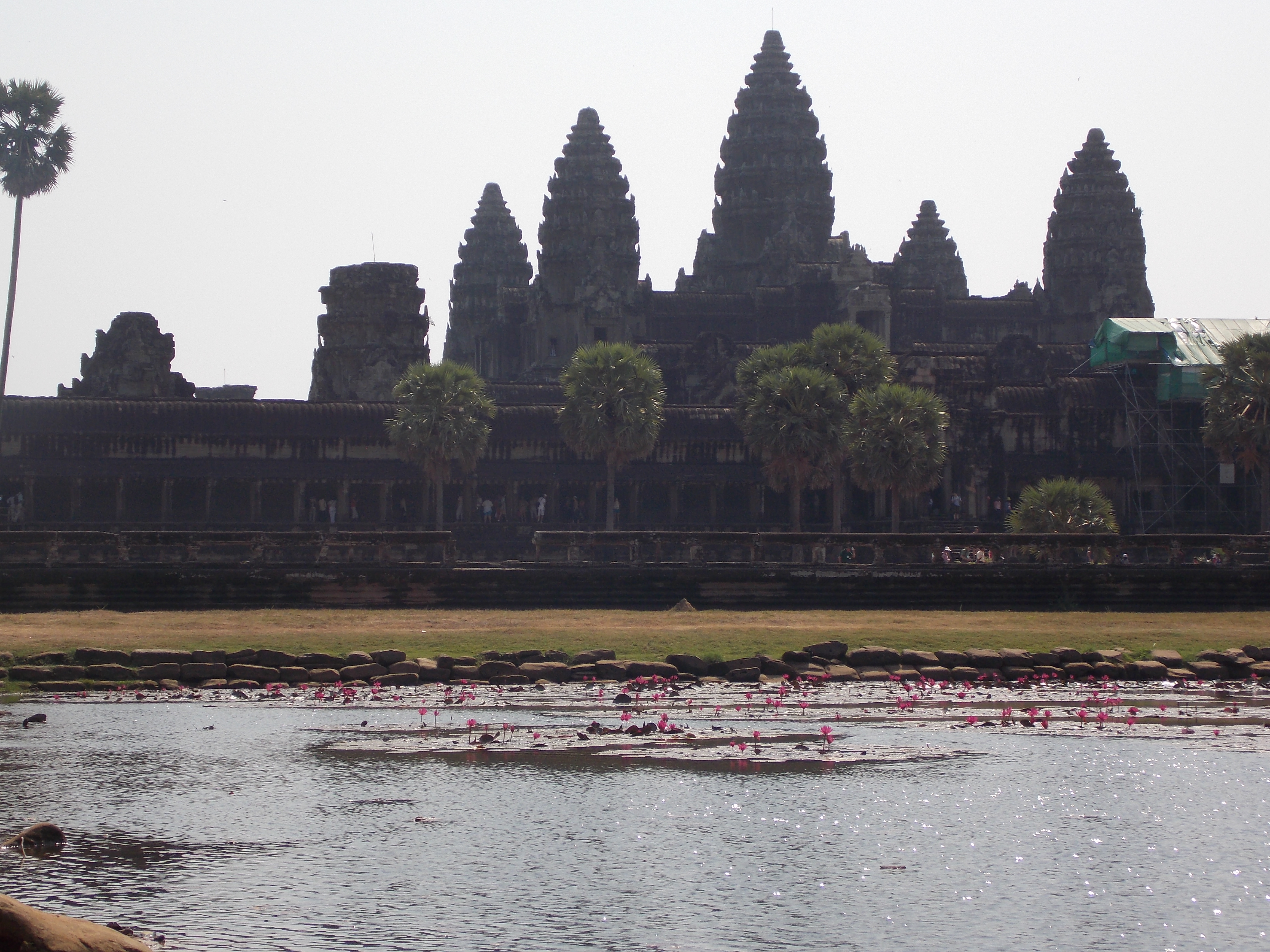
Angkor Wat

Angkor Wat

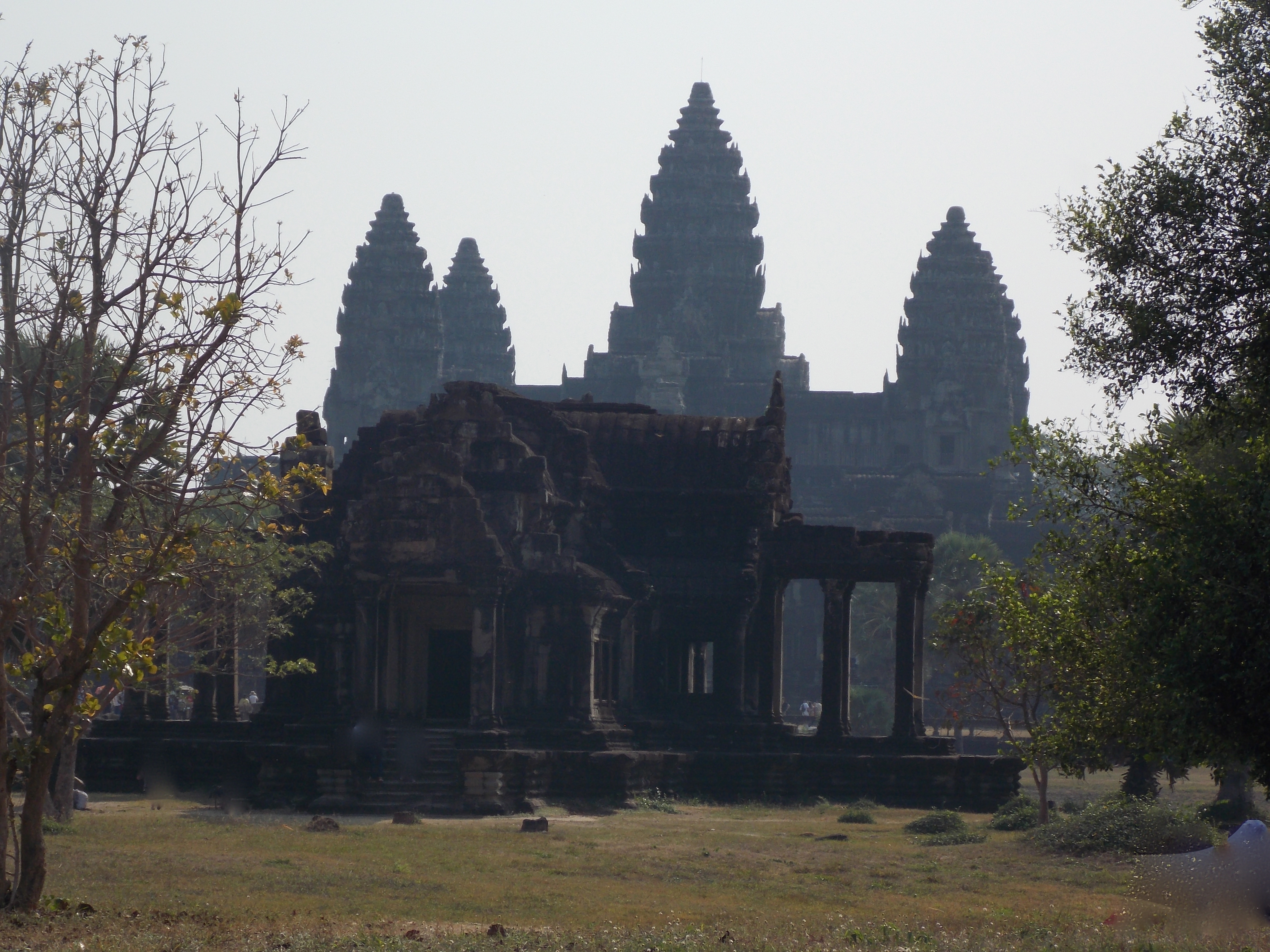
First thing the next morning we visited the magnificent Angkor Wat, the largest religious monument in the world. It was built between 1113-1150 by king Suryavarman II, employing 300,000 men and 3,000 elephants. It was originally a Hindu temple dedicated to the god Vishnu, and is still a functioning religious center but now it is Buddhist; there were a number of shrines within the ruins where Buddhists had come to pray amidst the thousands of tourists.

DSCN2131

After entering through the west gate, the king’s gate, I left my group and walked to the far side of the compound to the east gate, where the commoners used to enter. It was shaded and peaceful there, with far fewer people, a couple of lakes and a family of monkeys. With the sun behind me I tried to get some interesting angles on the five main towers, which are shaped like lotus flowers that have yet to blossom. Angkor Wat definitely does not disappoint; it is a powerful place that captures the imagination and takes you back 1000 years, in wonderment of what this unique and sophisticated civilization must have been like, and what it might have become.

The bottled water is always safer.

The bottled water is always safer.

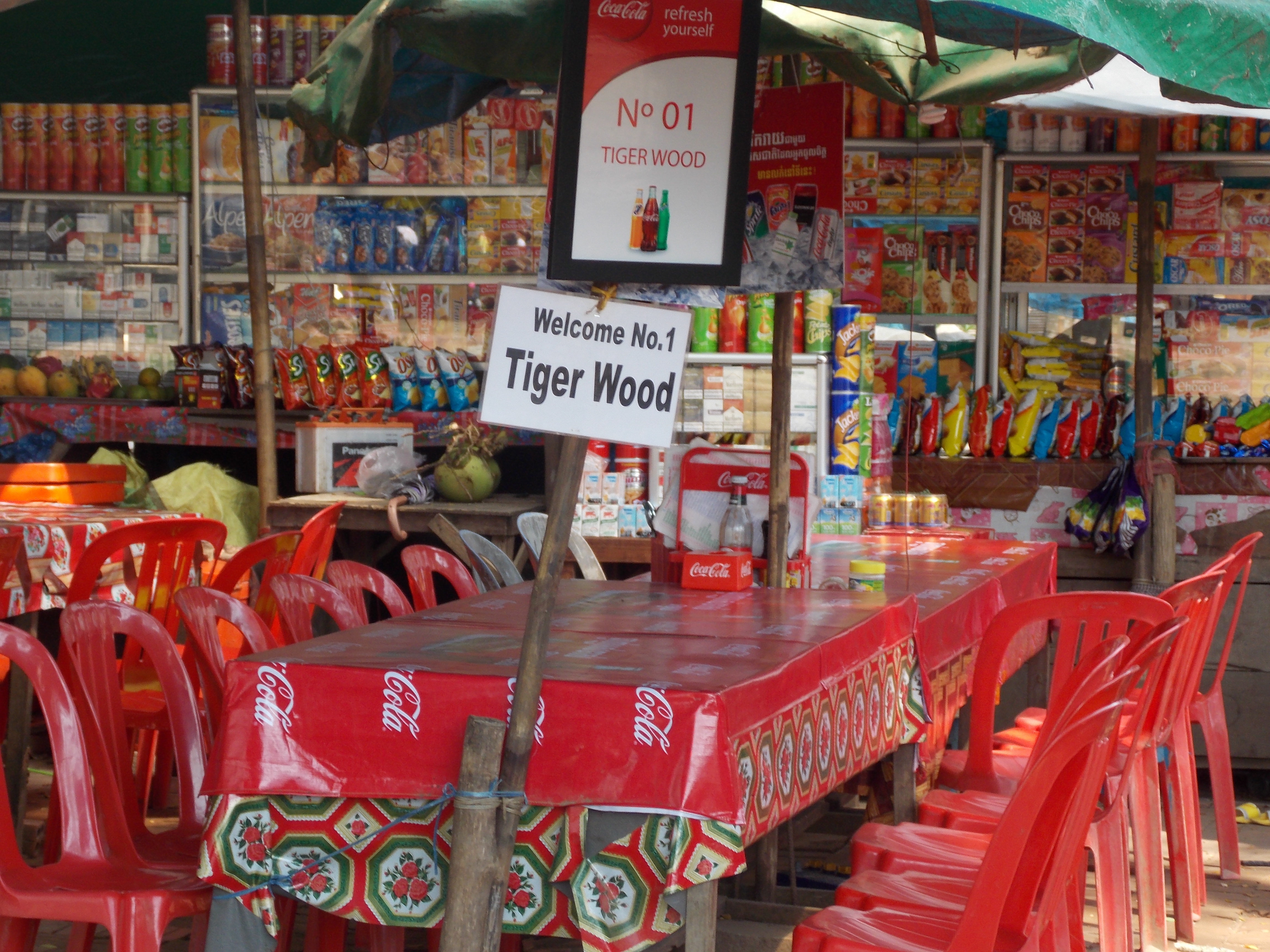
There is a market (of course there is) adjacent to the temple within the grounds. At a small café’ each table is named for a celebrity: John Rambo, Harry Potter, Lady Gaga, Angelina Jolie, James Bond … and Tiger Wood. I asked the guy hustling me why they did that. He said: “Maybe if people see person they like, they stay to eat.” I asked if it worked and he just shrugged. I didn’t correct him on the spelling of Tiger’s name; I was just amused that his popularity has reached as far as the jungles of northern Cambodia.

DSCN2153

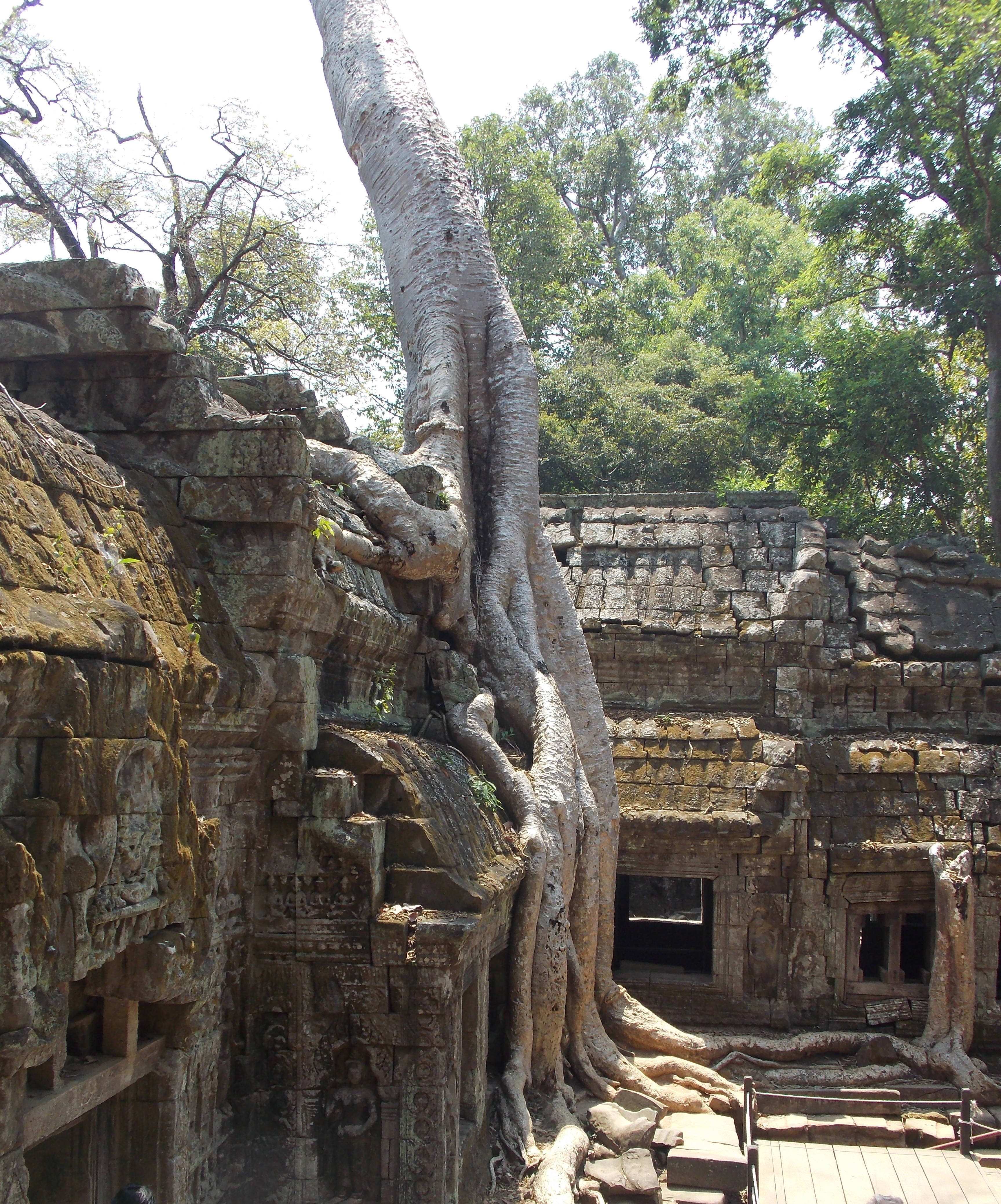
Later we went to the Tomb Raider temple, so called because the Angelina Jolie movie of that name was filmed there in 2001. The resulting publicity and traffic have taken a toll and much of the grounds are under construction and renovation.

The jungle is taking over the Tomb Raider Temple.

The jungle is taking over the Tomb Raider Temple.

We had two evenings to enjoy the city of Siem Reap (“The Defeat of Siam”), which has 300,000 permanent inhabitants and receives 3.5 million visitors per year. There is a terrific night market no more than a ten-minute tuk tuk ride from wherever your hotel is; the streets are alive with bars and restaurants, clothing and art shops, every conceivable accent and dozens of massage places on the street, where you can get incredible 15-minute foot massages for a dollar.

Oh, how it tickles!

I’m not sure this was worth a free beer.

The more interesting massage is called Doctor Fish. You sit on the edge of a large fish tank filled with one- to three-inch garra rufa fish, also known as the reddish log sucker, nibble fish and physio fish. You recoil half a dozen times from the tickling before you can completely commit. Supposedly they are eating only the dead skin and cleaning off the dirt, and afterwards your feet do feel smoother, but it’s not the most comfortable sensation. It’s a dollar for ten minutes, and for two dollars you get 20 minutes and a free beer, quite a deal, and when you are with four other friends it’s a definite hoot. When I researched it later I discovered that certain agencies have called for the practice to be banned, believing that it could spread viruses like Hepatitis, which sounds like a bunch of BS to me.

But I don’t think I’ll tell the others.

Nice afternoon light on Angkor Thom

Nice afternoon light on Angkor Thom

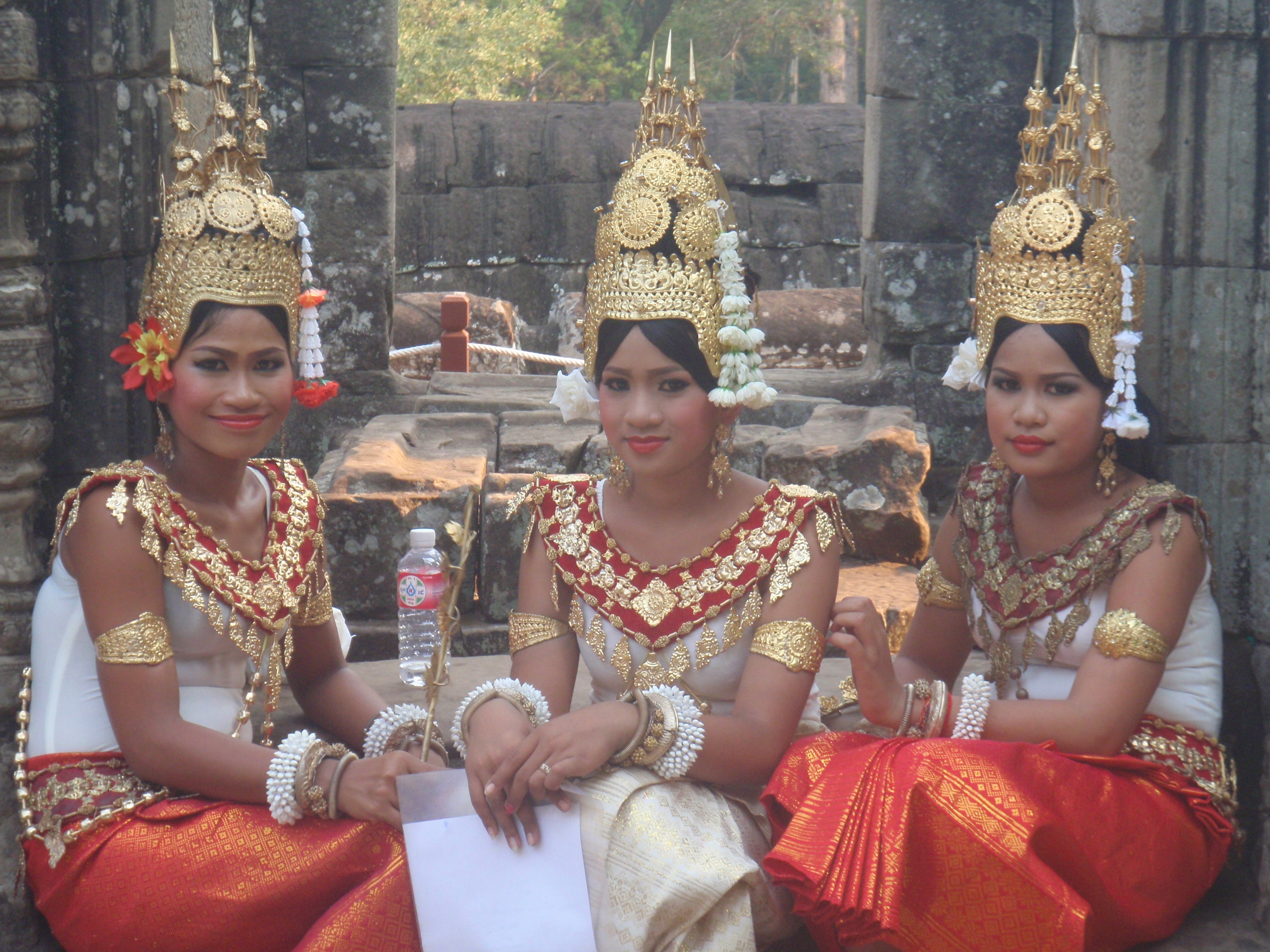
I'm not sure what they were doing there but they sure looked nice

I’m not sure what they were doing there but they sure looked nice

DSCN2199

In Cambodia, he's still #1.

In Cambodia, he’s still #1.

One of my favorite photos of the trip.

One of my favorite photos of the trip.

Categories: Uncategorized

Phnom Penh

For people around my age Cambodia evokes a couple of different thoughts. We probably remember during the Vietnam War that American troops were not supposed to be crossing the border to engage in any fighting but didn’t really have a choice. We might have some recollection of Pol Pot killing many of his own people there few years later. More recently, perhaps we’ve become aware of the enormous complex of temple ruins in Angkor. So not knowing much more than that I was curious to check it out.

I landed mid-afternoon on a flight from Bangkok and was on my own until the next morning, when I would join a tour group. At the airport in Phnom Penh I went to an ATM to get some local currency and it spit out dollars, very surprising. When I saw my cab driver pay a toll with dollars I asked him what was up. “We no get many American tourist,” Kim said, “but we have much American money.” In the course of four days here we would find vendors who wouldn’t even accept Cambodian money, only dollars. And we would learn that just one dollar buys so many things … a 20-minute tuk tuk ride, an outstanding 15-minute foot massage, and a good-sized bag of fried spiders.

In an effort to make this brief and painless, here are a few bullet points about the country and its history:

  • The first Kingdom in Cambodia, called the Phnom, was created in the first century A.D. by an Indian Brahmin priest and the local princess he married. He introduced Hindu customs and the Sanskrit language. It was the first Khmer kingdom and became the dominant power in the region for 600 years.
  • In 800 A.D. King Jayavarman II united the Khmer people and established the capital in the Siem Reap province, where Angkor Wat is today. He also changed the primary religion to Buddhism, and the country’s affiliation tended to vacillate depending on the allegiance of the King.
  • The golden age was between the 9th and 14th centuries, but in the 15th century the Ayatthuian Empire of Siam captured Angkor and dominated for 100 years, until Cambodia regained control.
  • Constantly under attack from its neighbors, especially Siam (Thailand) and Vietnam, the kingdom asked France for help and a protectorate was established in 1863. Along with Laos and Vietnam, Cambodia became part of French Indochina.
  • The country was granted its independence from France in 1949 and tried to stay neutral when the war in Vietnam broke out in 1963, but North Vietnam and the Viet Cong used eastern Cambodia as a staging area to attack South Vietnam, making neutrality impossible.
  • An indigenous Communist guerrilla movement called the Khmer Rouge (Red Khmers) began to put pressure on the western-supported government, and as fighting continued between North Vietnam and U.S. supplied troops even after the peace agreement of 1973, the Khmer Rouge forces, under the leadership of Pol Pot, overthrew the current regime.
  • Between 1975 and 1979 Pol Pot tried to install a Marxist agrarian society and in the process murdered more than two million people and effectively exterminated Cambodia’s professional and technical classes.
  • Pol Pot was ousted by Vietnamese forces in January, 1979, and after that it gets real hard to follow, but there have been attempts at free elections, lots of corruption, execution of political opponents as recently as 1993, and other nastiness. Pol Pot and 35,000 of his most loyal and deranged sidekicks fled to the jungle and tried to stage an unsuccessful comeback. He died in 1998 under house arrest from his own people, and is rumored to have been poisoned.
The King lives here, so they tell me.

The King lives here, so they tell me. He wouldn’t take my call.

  • The country is about the size of Missouri and has a population of almost 15 million, and is now a “multi-party liberal democracy under a constitutional monarchy.”
  • And finally, a bit of geography. Lake Tonle Sap is the largest fresh water lake in Southeast Asia, and the Tonle Sap River is the only river in the world that flows in both directions. Starting in June every year the river becomes so swollen that all the water can’t empty into the Mekong River at Phnom Penh so it starts back in the other direction, keeping the lake replenished. So tuck that away for your next trivia party.

I checked in to my hotel, cleaned up and hailed a tuk tuk. This is a wonderful form of transportation that has been prevalent in many places on this trip. In Africa they are called bajajis and are more like an enclosed golf cart,

In a tuk tuk you are definitely in the middle of the action.

In a tuk tuk you are definitely in the middle of the action.

with the driver inside. In India they are called auto rickshaws. In Nepal and Thailand they are also called tuk tuks and are pulled by bicycles. And in Cambodia they are nice carriages pulled by a motorcycle. Whatever the configuration, they are cheap and a great way to get where you want to go, if you don’t want to go too far.

Where I wanted to go that first night was an area down by the Mekong River where I was told there were some good restaurants. My driver’s name was Yel Phoungmara and he did a great job navigating the chaos of rush hour in Phnom Penh, and I did a great job of sitting back and letting him. He picked out a restaurant for me and when I tried to pay him he said: “No, pay later. I wait.” I told him I didn’t know how long I would be. “No matter. I wait.”

I sat down and ordered a chicken curry dish ($3.50) and a very large bottle of Angkor beer ($2.50). Immediately a kid came up to my table with a box of books … guidebooks, books on Cambodian history, books that would have told me I was in a tourist area if I hadn’t already noticed all the white people. As soon as I got rid of him a withered old man in a wheelchair approached, looked me dead in the eye and put out his hand. “No,” I said, a bit too firmly. I hate being a hard ass but you have to draw the line sometimes, and approaching me at a restaurant table is crossing it.

A few minutes later a young girl came up with another box of books, and the one she held up interested me: The Killing Fields. I asked how much. “One hundred dollars,” she said with a smile, “but you can bargain.” Her name was Ne, I liked her style and we concluded negotiations at $2.00. All the books looked new and were wrapped in cellophane. “How much do you pay for these books?” I asked her. She told me one dollar each. There must be some cheap and probably illegal black market reprinting racket going on here, but so far the book actually has all the pages in the right sequence.

Ne asked me if I wanted some weed; she looked so innocent! “No, I’m too old,” I laughed. “I’ll stick to this.” I took a swig of the Angkor. “I know plenty people older than you who smoke,” she said. “Plenty older people.” God bless you, child.

I ate and looked out at the boats on the Mekong River, which starts in the great mountains of Tibet and flows down through Burma, Thailand, Laos, Cambodia and Vietnam, where it forms the fertile Mekong Delta before emptying into the South Chin Sea. After dinner I asked Yel to take me to some non-touristy parts of town but no place I felt comfortable stopping, so we headed back to the hotel. I gave him 40,000 riel — about $10 — and he almost kissed me. With transportation, dinner and the book my wild night out in Phnom Penh had set me back $19.50, and I had made one tuk tuk driver very happy in the process. A good night.

The next morning I met my tour group including my friend Maria Dancsak, whose boyfriend is an old college buddy; Maria was born in Hungary and I had dinner with her cousin Lazlo when I was in Budapest. The tour group seems full of nice people around my age or a bit older, and I learned quickly that these are folks who love to travel and do it a lot.

Wat Phnom

Wat Phnom

We saw some temples that first morning including the beautiful Wat Phnom, where there were some more young entrepreneurs. Dealing with these kids was clearly going to be an ongoing challenge because they are relentless, but at least they are selling something and not asking for handouts. If they buy bottles of water for $.50 and sell

Naan, the bird boy of Wat Phnom.

Naan, the bird boy of Wat Phnom.

them for a dollar, it’s hard to find fault with that. And at this temple we met Naan, a young kid who had a great scam. He had a plastic bag full of baby birds and bird seed, and he would sell you two birds for one dollar so you could let them go. Of course he would just go catch them again and resell them, but you had to love his inventiveness. I ponied up for a buck and when I saw him again later there was a line of Koreans waiting to free some birds … Naan was raking it in, and good for him.

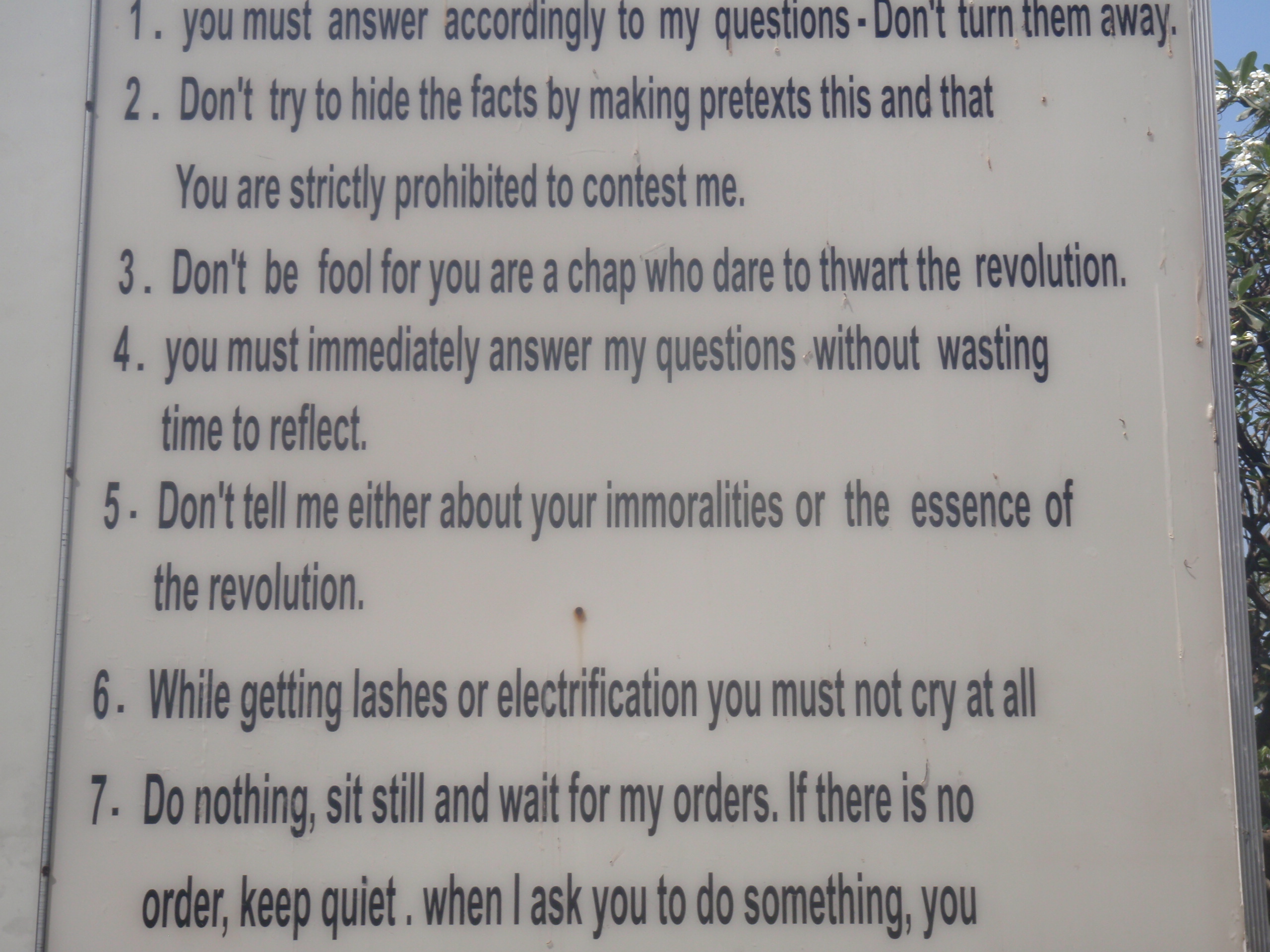
That afternoon we visited the Tuol Sleng Genocide Museum, where the atrocities of the Khmer Rouge really hit home. The leader was born Saloth Sar but started calling himself Pol Pot for “Political Potential”, and became a homicidal tyrant the equal of Stalin and Hitler. He believed that Cambodia’s future was tied to agrarian socialism, and he evacuated all the cities and forced everyone into the countryside to collective farms. Phnom Penh became a ghost town. Those who resisted were killed, along with their families. Those representing specific ethnic minorities were killed, along with their families. Those with any affiliation to the previous government were killed, along with their families; Pol Pot

Interesting Prison Rules

Interesting Prison Rules

didn’t want any children around who might some day seek revenge. Estimates vary, but it’s believed that the Khmer Rouge murdered and tortured and otherwise caused the death of well over two million people, in a country of just eight million.

The Genocide Museum used to be a prison for officials of the old democratic government, a place where they would be held and tortured; often they would be hung upside down until they lost consciousness, and then dunked into a large urn of sewage until they revived for more interrogation.  Ultimately they would be taken to the infamous killing fields at Choeung Ek, where a memorial today still contains more than 5,000 human skulls.

So … cheerful stuff. But this recurring theme of one man’s capacity for evil and the lemming-like willingness of so many to follow him is a disturbing thread on this trip. Anyway, in a day or two we’ll move north to the complex at Angkor, the most Indiana Jonesy place you will ever see, and of course the ruins of the greatest temple of all, Angkor Wat. (And also a really cool monkey picture!)

Categories: Uncategorized

A True Thai Vacation

Some people have suggested that I’m basically on a one-year vacation and I guess there is some truth to that, but I’ve tried to approach this journey more as a student than a tourist, so it hasn’t always felt that way. The past ten days, however, during which I have had a lovely traveling companion to help share the ride, has felt like a true vacation, with unique adventures and a great deal of relaxation.

Kenny G stopped by our table on the river cruise.

Thailand’s answer to Kenny G stopped by our table on the river cruise.

Elle has to be one of the world’s bravest women to fly exactly halfway around the earth to hang out for ten days with a guy she didn’t know very well, but when I met her over a year ago she impressed me with her spirit of adventure, and when she accepted an invitation to come join me for while, I knew she was a kindred soul. She

adjusted quickly following a 25-hour flight, and we hit Thailand running with two days in Bangkok, two days up north in Chaing Mai, and finally three days back south at the beach near Hua Hin, with transition days in between.

In Bangkok we did a river cruise one evening which reminded me of New Years Eve on the Bosporus … great company, average food and cheesy entertainment. But it was a lovely night punctuated with views of the Royal Palace and a number of riverfront temples, lit dramatically.

Bangkok's Royal Palace

Bangkok’s Royal Palace

The following night we had a phenomenal dining experience at a restaurant called Issaya, recommended by friends who know the local scene well, and after dinner we took a cab to Soi Cowboy, which I felt Elle needed to see. But the entire street was closed because of a Buddhist holiday; this quarter-mile of neon decadence was reduced by religious observance to a dark and ominous alley. But hey, even working girls deserve a night off.

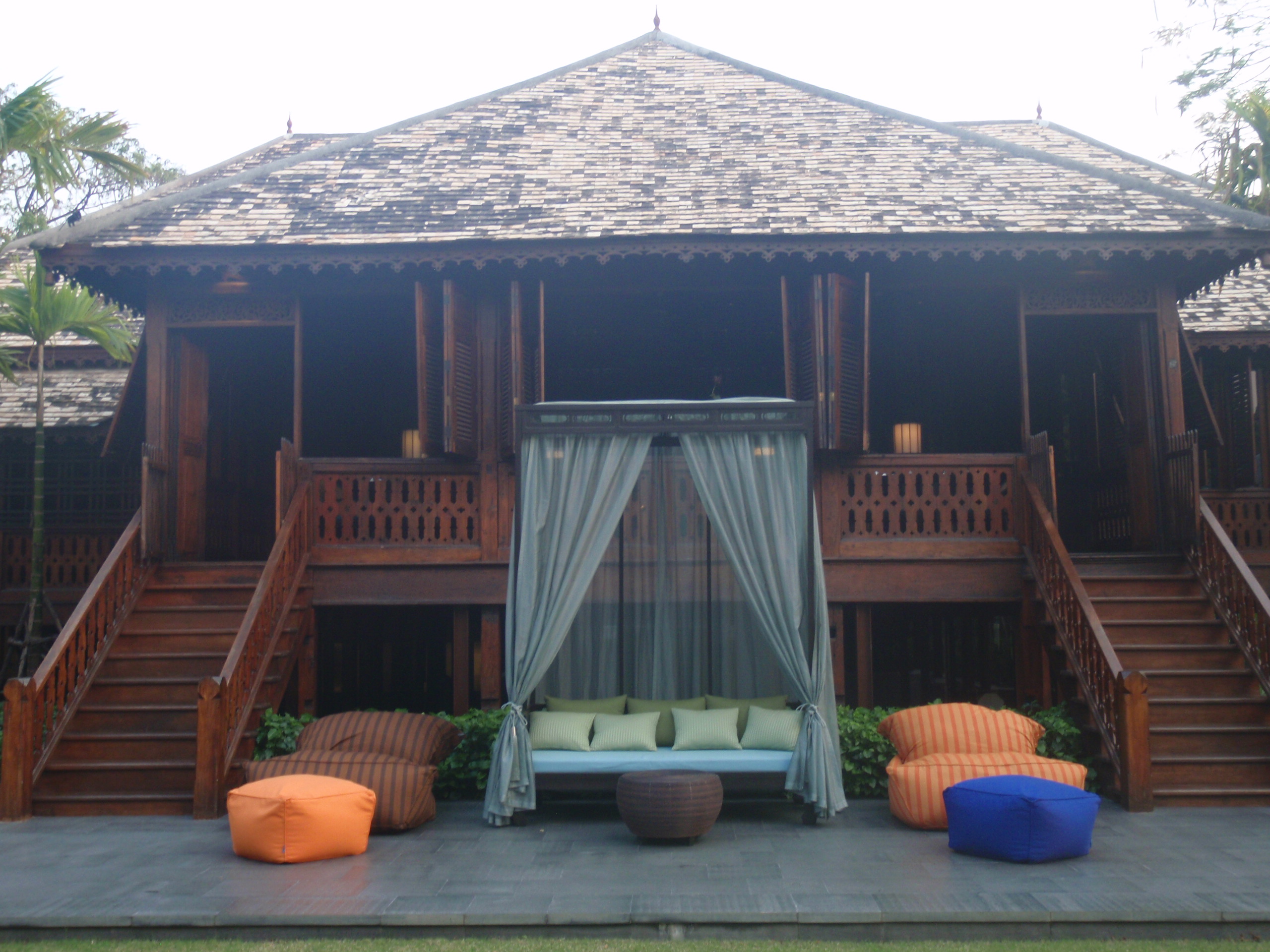
Chaing Mai is the second-largest city in Thailand and only a 55-minute flight north of Bangkok, but it has a laid-back vibe that makes it distinctive. Because of my fortuitous stumbling around the Internet we stayed at a wonderful place called 137 Pillars House, the history of which ties back to Anna Leonowens, of Anna and the King fame.

Anna was a penniless, widowed schoolteacher with two children when she was summoned by The Borneo Company to open a school for the King of Siam, around 1860. Her relationship with the King has been romanticized in a book called Anna and the King of Siam and later by the Broadway musical and film “The King and I”, but her impact to this country is undeniable. One of her students, Prince Chulalongkorn, eventually became the most revered King in Thailand’s history, Rama V (the current King is Rama IX). His enlightened initiatives – including the abolition of slavery – were considered to have come directly from the lessons of freedom and equality he learned from Anna.

OLYMPUS DIGITAL CAMERA

Anna’s son Louis was invited by the King to join Siam’s Royal Cavalry, which he did. Many years later Louis found a beautiful black wood home and moved it to the other side of the Ping River. It changed hands a number of times, was abandoned and overgrown but eventually purchased by the company who owns it now, and named for its number of teak columns: Baan 137 Sao, or 137 Pillars House. It is now an exceptional boutique hotel.

Our one full day in Chaing Mai included the following:

An authentic Thai market. We were the only “farang”, or foreigners, so it was special opportunity to see so many tiny women on their haunches grilling prawns, carving coconut, folding clothes. We bought fried banana chips, fried sweet potatoes and pork rinds that sustained us through the day.

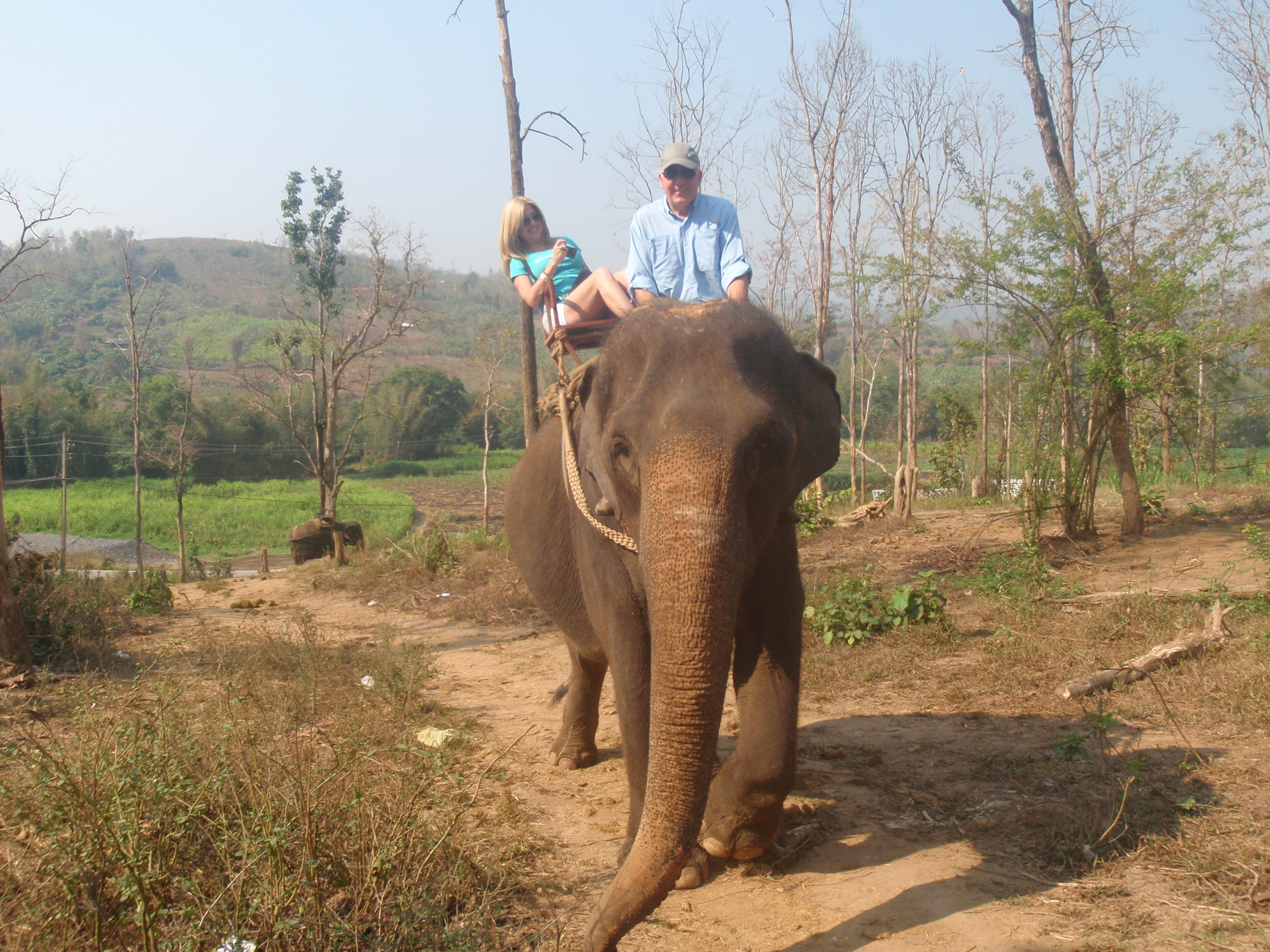
An elephant ride. It was fairly uneventful for the first five minutes but then our “driver” hopped off and pointed to me, and I inched my way out onto Nomi’s neck. When you are in that position you have two responsibilities: don’t fall off, and feed the beast. In the course of our ride we went through six enormous bags of bananas; when he stopped moving and his trunk came back into your lap you had better put a banana by those nostrils or you are not going anywhere. Elle took her turn in front as well as we went up and down some hills and into a river bed before climbing back up to the disembarkation station. It was a surprising amount of fun.

OLYMPUS DIGITAL CAMERA

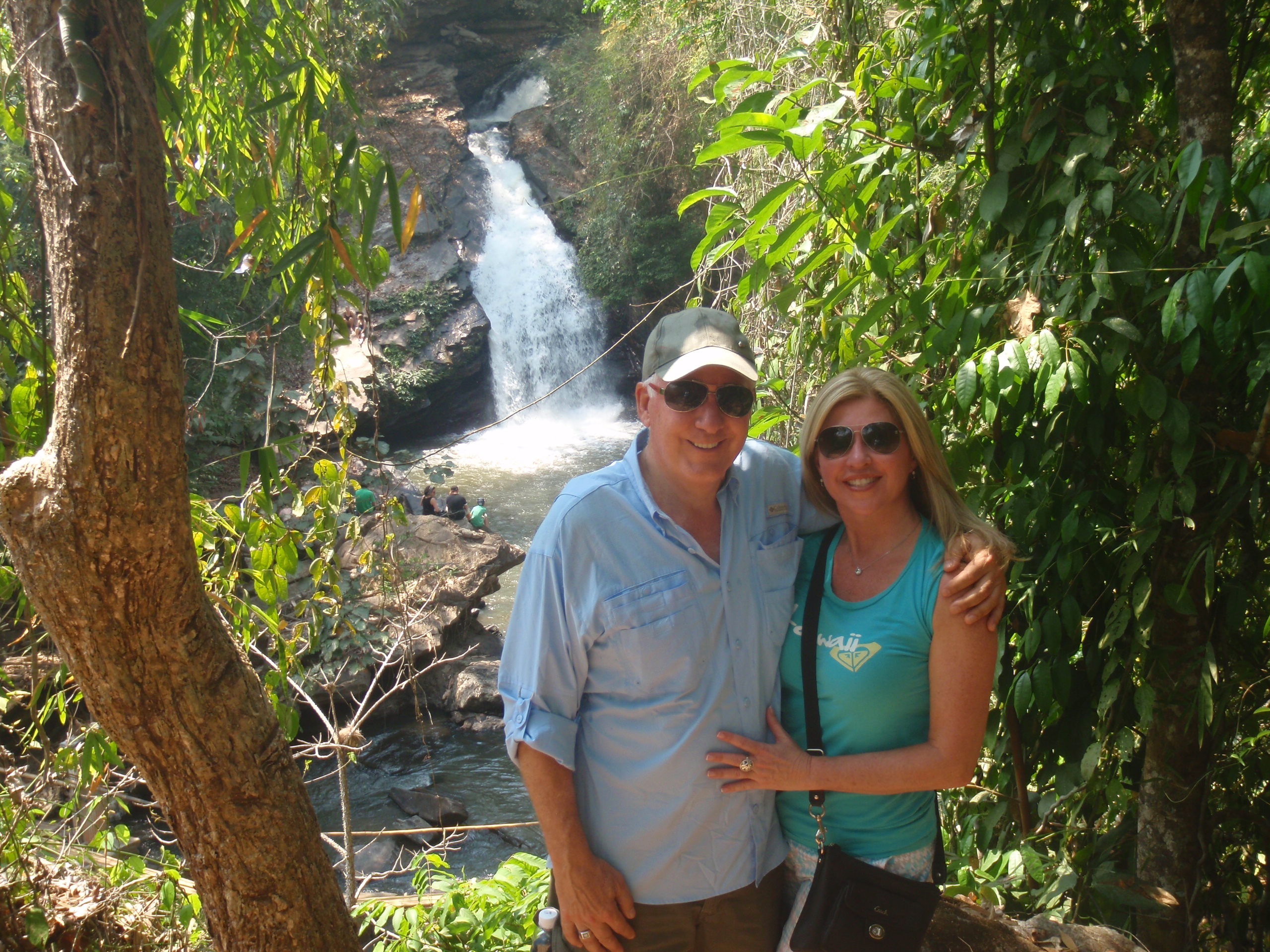
A jungle trek.  Our guide, who just said to call him Oh, led us on a 90-minute hike through the jungle, past some rice paddies and cornfields, up and down some hills to a waterfall, and finally back up a steep slope to the OLYMPUS DIGITAL CAMERAwaiting car. It was a beautiful excursion and not a bad little workout.

An ant omelet for lunch.  Well OK, a couple of bites of an ant omelet. Mr. Oh had purchased some ants and ant larvae at the market that morning and when we stopped for lunch he had his bag of goodies cooked up with some eggs. It wasn’t bad, and if I ever see it on a menu somewhere … there is not a chance in hell I will order it.

A river float on a bamboo raft. The raft was long but narrow, just nine bamboo poles wide. There are white-water rafting experiences available in Thailand and this was hardly that, but there were some tasty little rapids on this stream that get your attention when you are standing in the back with a pole, pretending to help the professional up front. That lasted until my pole got caught in some rocks and yanked me back onto my butt, where I stayed contentedly for the remainder of the trip. It was a peaceful ride except when the driver would whack the water with his pole and yell, “snake”.  I figured it was just part of the show until I saw a couple of sticks start to slither away.

BAMBOO RAFT

We had dinner that night on the outdoor porch at 137 Pillars House, and at one point saw some strange lights in the sky; there were four of them in formation that appeared to be stationary, and a fifth that seemed to be joining them. Close Encounters of the Thai Kind! When we pointed them out to our waiter he said, “Oh, flying lanterns.” They were probably part of a wedding ceremony, and an interesting end to an amazing day.

The following morning on the way to the airport for the flight back to Bangkok, we stopped at a village that OLYMPUS DIGITAL CAMERAfeatured members of eight different tribes. The real attraction is the Pagaung, an ethnic minority from Burma who are also known as the longneck tribe. The tribal belief is that the longer a women’s neck, the more attractive she is, so at age five or six girls start wearing brass coils around their neck, increasing the number of rings each year to push down the shoulder blades and elongate the neck. Human rights groups have tried to get the practice stopped but it generates a lot of revenue from tourists like us, so on it goes.

On the drive from Bangkok to the beach at Hua Hin the following day we stopped at Thailand’s original Floating Market, at Damneon Sadoak. One of the older James Bond films included a scene shot there, and there’s a mystical quality to these narrow waterways that pass by hundreds of shops with a lone shopkeeper squatting by the water, waiting for business, and on the wider waterways, homes adorned with plants and flowers. Some vendors navigate their own longboats with a paddle, selling bananas and mangoes and bottles of water or juice or beer. The canals intersect and often get so jammed with boats that you can walk from one side to the other on the boats.

OLYMPUS DIGITAL CAMERA

The next three days were nothing but relaxing at Aleenta, a wonderfully remote and beautiful resort on the Gulf of Thailand, 40 kilometers south of the resort town of Hua Hin. We had been warned that the water was not good for swimming because of jellyfish, but we found everything about it to be perfect. Elle spotted one jellyfish about the size of a champagne cork, and that was it. At night there were lights from so many fishing boats offshore it looked like the coastline of Miami Beach.

We spent our time there getting too much sun, watching the kite surfers capitalize on the afternoon wind, riding bikes, getting brutal 90-minute, $10 Thai massages at an open storefront across the street, and dreading having to leave.

But as I post this Elle is on a plane to Tokyo before the long flight over Alaska back to Atlanta, and I’m getting ready to head to the airport for a flight to Phnom Penh for a couple of weeks in Cambodia and Vietnam, before I also head back across the Pacific. All good things come to an end, and these ten days have been a good thing indeed.

Musical Interlude

My ultimate fantasy … oh, to be able to do this!

Categories: Uncategorized

Blog at WordPress.com.